
Instantly download AI-103日本語 training test engine

Pass4training offer you the best valid and useful Microsoft AI-103日本語 training material
Last Updated: Nov 25, 2026
No. of Questions: 152 Questions & Answers with Testing Engine
Download Limit: Unlimited
Complete & valid AI-103日本語 training questions for 100% pass!
Pass4training has a strong professional team who are devoting to the research and edition of the AI-103日本語 training test, thus the high quality and validity of Developing AI Apps and Agents on Azure (AI-103日本語版) torrent pdf can be guaranteed.You can easily pass the actual test with AI-103日本語 study material.
100% Money Back Guarantee
Pass4training has an unprecedented 99.6% first time pass rate among our customers.  We're so confident of our products that we provide no hassle product exchange.
- Best exam practice material
- Three formats are optional
- 10 years of excellence
- 365 Days Free Updates
- Learn anywhere, anytime
- 100% Safe shopping experience
- Instant Download: Our system will send you the products you purchase in mailbox in a minute after payment. (If not received within 12 hours, please contact us. Note: don't forget to check your spam.)
Microsoft AI-103日本語 Practice Q&A's

- Printable AI-103日本語 PDF Format
- Prepared by AI-103日本語 Experts
- Instant Access to Download
- Study Anywhere, Anytime
- 365 Days Free Updates
- Free AI-103日本語 PDF Demo Available
- Download Q&A's Demo
Microsoft AI-103日本語 Online Engine

- Online Tool, Convenient, easy to study.
- Instant Online Access
- Supports All Web Browsers
- Practice Online Anytime
- Test History and Performance Review
- Supports Windows / Mac / Android / iOS, etc.
- Try Online Engine Demo
Microsoft AI-103日本語 Self Test Engine

- Installable Software Application
- Simulates Real Exam Environment
- Builds AI-103日本語 Exam Confidence
- Supports MS Operating System
- Two Modes For Practice
- Practice Offline Anytime
- Software Screenshots
If your version ever falls behind, you will hear it from us first. When the AI-103日本語 exam materials are being revised, we notify you and send the updated version as soon as it is ready — free within your 365 days of updates at Pass4training. Nobody should study from stale Microsoft Developing AI Apps and Agents on Azure (AI-103日本語版) content.
Microsoft AI-103日本語 Exam Overview:
| Certification Vendor: | Microsoft |
|---|---|
| Exam Name: | Developing AI Apps and Agents on Azure |
| Exam Number: | AI-103 |
| Certificate Validity Period: | 1 year (renewable annually via free online assessment) |
| Related Certifications: | Microsoft Certified: Azure AI Engineer Associate (retiring June 30, 2026) |
| Exam Format: | Scenario-based, Case study, Performance-based items, Multiple choice |
| Passing Score: | 700 / 1000 |
| Exam Duration: | 100 minutes |
| Exam Price: | $165 USD (varies by country/region) |
| Available Languages: | Portuguese (Brazil), Japanese, French, Spanish, German, Korean, Chinese (Simplified), English |
| Real Exam Qty: | 50–60 |
| Recommended Training: | Azure AI Foundry Documentation Microsoft Learn: Develop AI Apps and Agents on Azure |
| Exam Registration: | Microsoft Certification Dashboard Pearson VUE Registration |
| Sample Questions: | DOWNLOAD DEMO |
| Exam Way: | Online proctored or onsite at Pearson VUE test centers |
| Pre Condition: | No mandatory prerequisites; recommended experience: 6+ months building AI applications, proficiency in Python or C#, familiarity with Azure services and AI concepts |
| Official Syllabus URL: | https://learn.microsoft.com/en-us/credentials/certifications/resources/study-guides/ai-103 |
Microsoft AI-103日本語 Exam Syllabus Topics:
| Section | Weight | Objectives |
|---|---|---|
| Topic 1: Implement text and speech analysis solutions | 10–15% | - Implement speech capabilities
|
| Topic 2: Implement computer vision solutions | 10–15% | - Implement image analysis and processing
|
| Topic 3: Plan and manage Azure AI solutions | 25–30% | - Design Azure AI infrastructure
|
| Topic 4: Implement information extraction and knowledge mining | 10–15% | - Build knowledge bases and search solutions
|
| Topic 5: Implement generative AI and agentic solutions | 30–35% | - Build generative AI applications
|
The Microsoft Developing AI Apps and Agents on Azure (AI-103日本語版) Exam: What to Know First
Currency is maintained daily, not occasionally. Our IT staff reviews and updates the Microsoft Developing AI Apps and Agents on Azure (AI-103日本語版) question bank every day to keep it aligned with the live AI-103日本語 exam. If a revision is underway when you buy or during your update period, we notify you and send the updated version as soon as it is ready — free within your 365 days of updates. You will never be left studying a stale edition without knowing it.
The AI-103日本語 exam is the official assessment behind the Microsoft Developing AI Apps and Agents on Azure (AI-103日本語版) certification from Microsoft, and its pass rate is genuinely low — many candidates need two or three attempts to get through. The difficulty is real, but it is also manageable: candidates who prepare with material aligned to the published objectives give themselves a far better starting position than those who walk in underprepared.
Registration for the AI-103日本語 exam runs through these official channels:
Given how commonly this exam takes more than one attempt, schedule your sitting only when your practice results say you are ready.
The official outline divides the AI-103日本語 exam into weighted domains, including:
- Implement text and speech analysis solutions (10–15%)
- Implement information extraction and knowledge mining (10–15%)
- Implement generative AI and agentic solutions (30–35%)
The Microsoft Developing AI Apps and Agents on Azure (AI-103日本語版) question bank at Pass4training is updated daily against these same objectives, and the free practice test lets you sample that alignment yourself.
Microsoft recommends these training resources for candidates:
Official training builds the foundation; a daily-reviewed practice bank with expert-verified answers builds the exam-day readiness. Use both.
Only while you want us to. Update notifications about the Microsoft Developing AI Apps and Agents on Azure (AI-103日本語版) materials are sent because they are useful; once you have passed the AI-103日本語 exam, one email to our team opts you out completely — no junk mail, ever. Your personal information is kept secret and safe throughout, and never shared with third parties.
Passing the AI-103日本語 exam requires 700 / 1000, and registration costs $165 USD (varies by country/region) — per attempt. With retakes so common on this exam, preparing properly for one focused attempt is the choice that protects your budget.
The AI-103日本語 exam contains 50–60 questions with 100 minutes minutes to complete them. Practicing under the same time limit is the reliable way to make exam-day pacing feel familiar rather than frantic.
No mandatory prerequisites; recommended experience: 6+ months building AI applications, proficiency in Python or C#, familiarity with Azure services and AI concepts
Microsoft Developing AI Apps and Agents on Azure (AI-103日本語版) Sample Questions:
Agent1は、Contoso製品に関する顧客からの質問にのみ回答するように設定する必要があります。このソリューションは、ビジネス要件を満たさなければなりません。
あなたはどうすべきでしょうか?
- A. システムメッセージの指示を変更します。
- B. トップpサンプリングを適用する。
- C. 温度パラメータの値を増加させます。
- D. 少数の撮影例を追加します。
Correct Answer: A 🗳️
Explanation: Only visible for Pass4training members. You can sign-up / login (it's free).
App1という名前のPythonアプリケーションがあり、それがProject1という名前のMicrosoft Foundryプロジェクトと統合されています。
App1が以下の要件を満たしていることを確認する必要があります。
* Microsoft Entra マネージド ID を使用して認証します
* Azure OpenAI Responses API を使用して、dYouloyed モデルにプロンプトを送信します。Python コードをどのように完成させる必要がありますか?回答するには、回答領域で適切なオプションを選択してください。
注:正解ごとに1ポイントが加算されます。
Correct Answer:

Explanation:
credential = DefaultAzureCredential
response = openai_client.responses.create
The correct authentication class is DefaultAzureCredential because the requirement is Microsoft Entra-based authentication, and this credential supports managed identity in hosted Azure environments. The Microsoft Foundry quickstart for Python shows the project client being created with AIProjectClient (endpoint=PROJECT_ENDPOINT, credential=DefaultAzureCredential()), which enables the Foundry SDK to authenticate without using API keys or embedded secrets. The same guidance shows creating an OpenAI- compatible client from the project by calling project.get_openai_client().
The correct Responses API method is create because the application must send a new prompt to the deployed model and receive generated output. Microsoft's Foundry quickstart demonstrates the exact pattern: response
= openai.responses.create(model= " gpt-5-mini " , input= " ... " ), followed by reading response.output_text.
The retrieve operation is used to fetch an existing response, not submit a new inference request, and compact is not the correct method for generating a model response. AzureKeyCredential would violate the Microsoft Entra managed identity requirement, while ClientSecretCredential uses an application secret rather than managed identity. Reference topics: Microsoft Foundry SDK, AIProjectClient, Microsoft Entra authentication, DefaultAzureCredential, and Azure OpenAI Responses API.
あなたは、工場の生産ラインで製造された不良部品を検出するアプリケーションを開発しています。
構成要素は貴社のビジネスに特化したものです。
一般的な障害を検出するには、Azure Custom Vision API を使用する必要があります。
どの3つの行動を順番に実行すべきでしょうか?回答するには、行動リストから適切な行動を回答欄に移動させ、正しい順序に並べ替えてください。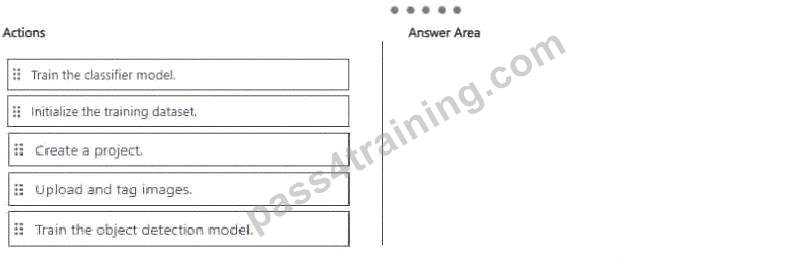
Correct Answer:

Explanation:
Azure Custom Vision uses a supervised machine-learning workflow. The first requirement is to create a Custom Vision project , where you select the project type and domain. Because the application must detect business-specific component faults, the model requires organization-specific labeled training images rather than relying solely on a general pretrained image-analysis capability.
Next, upload and tag representative images . For object detection, tagging includes drawing bounding regions around the faulty components or defect regions and associating those regions with appropriate tags.
Training quality depends strongly on having sufficiently varied examples representing lighting, orientation, component position, normal conditions, and defect types.
Finally, train the object detection model . Custom Vision uses the annotated regions to create a model capable of returning both the predicted tag and the bounding box for each detected fault. "Train the classifier model" is inappropriate because classification assigns a category to the overall image and does not provide object locations. "Initialize the training dataset" is not a separate required Custom Vision portal/API lifecycle step.
The AI-103 Study Guide maps this scenario to implement solutions that identify objects, components, or regions within images or video . Microsoft Learn
Microsoft Foundry プロジェクト内のマルチモーダルチャットモデルにリクエストを送信する App1 という名前の Web アプリケーションがあります。ユーザー メッセージには、テキストと画像の両方を含めることができます。現在、App1 はメッセージ コンテンツ内に画像 URL をプレーン テキストとして含めているため、モデルはそれらを画像として認識できません。テキスト部分と画像参照の両方を含む構造化配列としてメッセージを送信する必要があります。
- A. ユーザーメッセージコンテンツ配列に、タイプ: text とタイプ: image_url のアイテムを含めるように設定します。
- B. メタデータを要求するために画像URLを追加します。
- C. システムメッセージ内に画像URLを配置します。
- D. コンテンツ文字列内にbase64データを直接含めます。
Correct Answer: A 🗳️
Explanation: Only visible for Pass4training members. You can sign-up / login (it's free).
あなたは、PDF形式で保存されている人事(HR)ポリシーに関する質問に答えるソリューションを設計しています。
特定の質問に対して、毎回同じ回答が返されるようにする必要があります。また、開発の手間を最小限に抑えるソリューションでなければなりません。
ソリューションにはどのサービスを含めるべきでしょうか?
- A. Foundry Tools の Azure Document Intelligence
- B. Foundry ToolsにおけるAzure言語
- C. Azure OpenAI
- D. Azure Machine Learning
Correct Answer: B 🗳️
Explanation: Only visible for Pass4training members. You can sign-up / login (it's free).
Viewing page 1 out of 31 pages.
Viewing questions 1-5 out of 152 questions.
Over 70904+ Satisfied Customers

 Irene
Linda
Myra
Rosalind
Valerie
Allen
Pass4training is the world's largest certification preparation company with 99.6% Pass Rate History from 70904+ Satisfied Customers in 148 Countries.

Our Clients













Pass4training can not only provide you with the high quality study material for 100% pass, but also offer good afer-sales sevice to make all of you satisfied.
Contact Us
From Monday to Saturday
Support: Contact now
If you have any question please leave me your email address, we will reply and send email to you in 12 hours.