

Brilliant P_SAPEA_2023 Exam Dumps Get P_SAPEA_2023 Dumps PDF
P_SAPEA_2023 Dumps PDF - P_SAPEA_2023 Real Exam Questions Answers
NEW QUESTION # 19
When creating an application architecture roadmap, the WHAT and WHERE are defined in a rather straightforward way, while the WHOM may differ by context. Multiple roadmap clusters may apply a variety of WHOM dimensions. For example, procurement vs. asset management. Which of the following definitions are correct? Note. There are 3 correct answers to this question.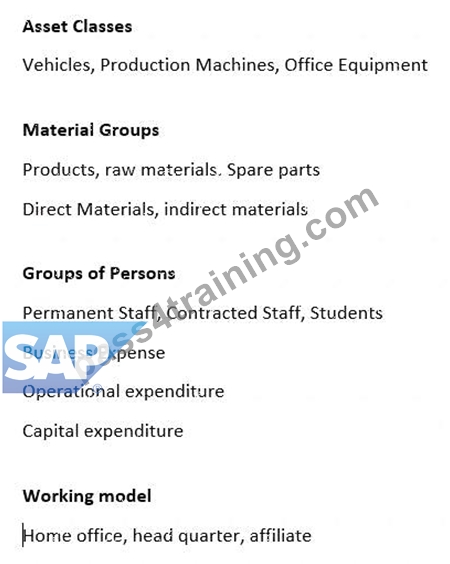
- A. Material Groups/Products, raw materials. Spare parts/Direct Materials, indirect materials
- B. Working model/Home office, head quarter, affiliate
- C. Groups of Persons/Permanent Staff, Contracted Staff, Students/Business Expense/Operational expenditure/Capital expenditure
- D. Asset Classes/Vehicles, Production Machines, Office Equipment
Answer: A,B,C
Explanation:
Explanation
The WHOM dimension of an application architecture roadmap defines the different groups of stakeholders or users that are involved in or affected by the application. The WHOM dimension can vary depending on the context and the scope of the roadmap. For example, in the context of procurement vs. asset management, the WHOM dimension could include material groups/products, groups of persons, and working model as possible clusters. These clusters represent different categories of items, people, and locations that are relevant for the procurement and asset management processes. For example:
Material groups/products: This cluster could include different types of materials or products that are procured or managed by the organization, such as raw materials, spare parts, direct materials, or indirect materials. These categories could have different requirements, standards, or regulations that affect the application architecture.
Groups of persons: This cluster could include different types of people that are involved in or benefit from the procurement and asset management processes, such as permanent staff, contracted staff, or students. These groups could have different roles, responsibilities, or access rights that affect the application architecture.
Working model: This cluster could include different modes or locations of work that are supported by the procurement and asset management processes, such as home office, head quarter, or affiliate. These modes or locations could have different technical, legal, or organizational implications that affect the application architecture.
The other option (A) is not a correct definition of a WHOM dimension cluster, because it does not represent a group of stakeholders or users, but rather a group of assets or resources that are managed by the organization.
Asset classes/vehicles, production machines, and office equipment are examples of WHAT dimension clusters, which define the different types of assets or resources that are relevant for the application architecture.
Verified References: Strategic Architecture Roadmap for Composable Enterprise Applications, What is an application architecture?, Phase C: Information Systems Architectures - Application Architecture
NEW QUESTION # 20
Wanderlust's CIO asks you to evaluate the SAP Enterprise Architecture Framework. At Wanderlust GmbH a non-SAP EA tool is used, How would you proceed with the request and why? Note: There are 2 correct answers to this question.
- A. I tell the CIO that the SAP EA Framework cannot be used because the Wanderlust GmbH uses a non- SAP EA tool. Therefore, further evaluation is not necessary.
- B. I evaluate both the SAP EA Methodology and TOGAF ADM. I recommend the approach that fits best Wanderlust's requirements.
- C. I tell the CIO that the SAP EA Framework also encompasses architecture services and practices. Based on a cost-benefit analysis I consider using the services and practices that fit best the project.
- D. I check whether the SAP Reference Business Architecture and Reference Solution Architecture Content can help to either define the scope of the architecture work or describe a target architecture structure. If they do, I suggest to use the Reference Architecture Content of SAP.
Answer: B,D
Explanation:
When evaluating the SAP Enterprise Architecture Framework for Wanderlust GmbH, you should proceed with the following steps:
I evaluate both the SAP EA Methodology and TOGAF ADM. I recommend the approach that fits best Wanderlust's requirements. This step is necessary because the SAP EA Methodology is based on TOGAF ADM, but extends it with additional elements and guidance specific to SAP solutions and customers4. Therefore, you need to compare and contrast the two methodologies and assess which one suits Wanderlust's needs better. For example, you may consider factors such as the complexity, scope, scale, and objectives of Wanderlust's architecture projects, as well as the availability of resources, skills, and tools.
I check whether the SAP Reference Business Architecture and Reference Solution Architecture Content can help to either define the scope of the architecture work or describe a target architecture structure. If they do, I suggest to use the Reference Architecture Content of SAP. This step is beneficial because the SAP Reference Business Architecture and Reference Solution Architecture Content provide a set of pre-defined architectures that cover common business scenarios and solution domains for SAP customers5. Therefore, you can use them as a starting point or a reference point for your architecture work, as they can help you to define the scope, requirements, capabilities, components, patterns, and best practices for your architecture solutions.
Verified : 4: https://help.sap.com/docs/SAP_ENTERPRISE_ARCHITECTURE_FRAMEWORK/60bc20e6e0a24426a817705bcb415220/144c6c88c10a493e985f71bd62f3c905.html?locale=en-US&state=PRODUCTION&version=1.0 | 5: https://help.sap.com/docs/SAP_ENTERPRISE_ARCHITECTURE_FRAMEWORK/60bc20e6e0a24426a817705bcb415220/01b0590c66854a5a94796ef0b47c8fcc.html
NEW QUESTION # 21
You, as the Chief Enterprise Architect of Wanderlust GmbH, have been trying to formulate the Business Strategy Map. You are currently working on the strategic objective to "Increase supply reliability of Lithium batteries". Arrange the elements of the Business Strategy Map into the right order that shows the dependencies between these elements.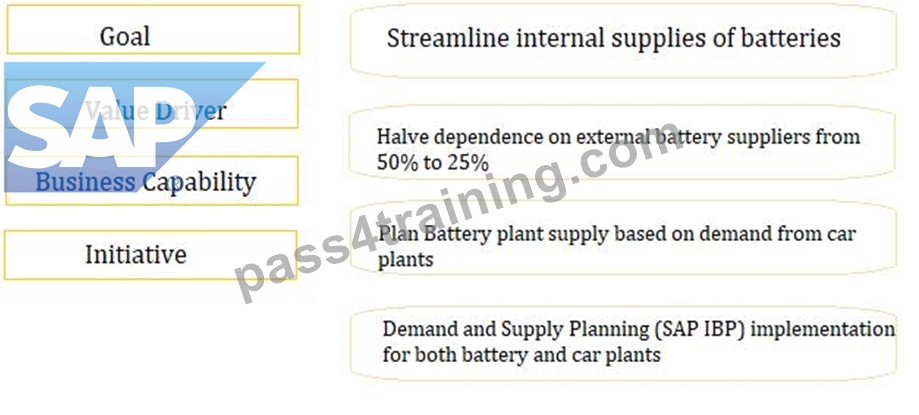
Answer:
Explanation: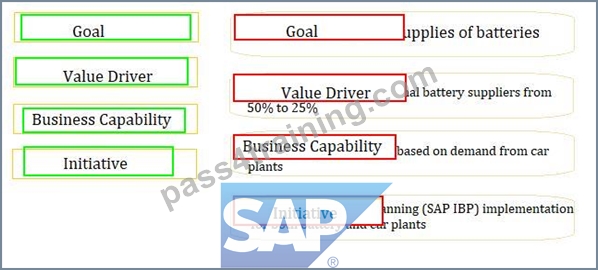
NEW QUESTION # 22
Green Elk & Company is the world's leading manufacturer of agricultural and forestry machinery. The former company slogan "Elk always runs" has recently been changed to "Elk feeds the world". One of Green Elk's strategic goals is to increase its revenue in the emerging markets of China, India, and other parts of Asia by 80 % within three years. This requires a new business model that caters to significantly smaller farms with limited budgets. You are the Chief Enterprise Architect and the CIO asks you to assess the now business model for smaller farms with smaller budgets. By applying the Sustainable Business Model Canvas, which sequence of steps is best practice?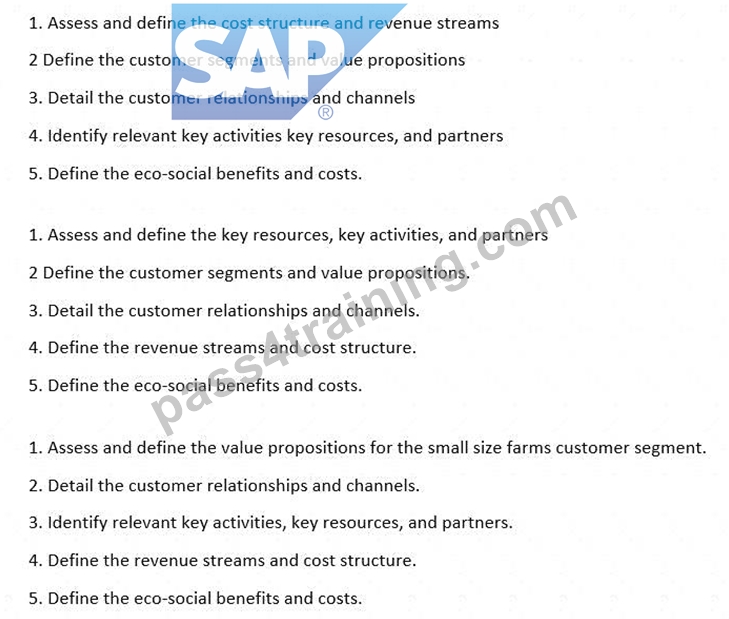
- A. 1. Assess and define the key resources, key activities, and partners
2 Define the customer segments and value propositions.
3. Detail the customer relationships and channels.
4. Define the revenue streams and cost structure.
5. Define the eco-social benefits and costs. - B. 1. Assess and define the cost structure and revenue streams
2 Define the customer segments and value propositions
3. Detail the customer relationships and channels
4. Identify relevant key activities key resources, and partners
5. Define the eco-social benefits and costs. - C. 1. Assess and define the value propositions for the small size farms customer segment.
2. Detail the customer relationships and channels.
3. Identify relevant key activities, key resources, and partners.
4.Define the revenue streams and cost structure.
5. Define the eco-social benefits and costs.
Answer: C
Explanation:
Explanation
According to the Sustainable Business Model Canvas, which is a tool that helps entrepreneurs to design and communicate their business models in a sustainable way, the recommended sequence of steps is:
Assess and define the value propositions for the small size farms customer segment. This step involves defining and describing the products or services that Green Elk & Company offers to its target customers, and how they create value for them. The value propositions should address the needs, problems, or desires of the customers, and highlight the benefits or advantages of Green Elk & Company's solutions over the alternatives.
Detail the customer relationships and channels. This step involves defining and describing how Green Elk & Company interacts with its customers, and how it reaches and delivers its products or services to them. The customer relationships should reflect the type and level of engagement that Green Elk & Company wants to establish and maintain with its customers, such as self-service, personal assistance, or community. The channels should reflect the most effective and efficient ways to communicate and distribute Green Elk & Company's value propositions to its customers, such as online platforms, physical stores, or partners.
Identify relevant key activities, key resources, and partners. This step involves identifying and describing the main activities, resources, and partners that Green Elk & Company needs to perform and leverage to create and deliver its value propositions to its customers. The key activities should reflect the most important tasks or processes that Green Elk & Company undertakes to execute its business model, such as production, marketing, or sales. The key resources should reflect the most essential assets or inputs that Green Elk & Company requires to execute its business model, such as human, physical, financial, or intellectual resources. The key partners should reflect the most strategic relationships or collaborations that Green Elk & Company establishes with other entities to execute its business model, such as suppliers, distributors, or competitors.
Define the revenue streams and cost structure. This step involves defining and describing how Green Elk & Company generates income from its customers, and how much it spends to execute its business model. The revenue streams should reflect the sources and mechanisms of income that Green Elk & Company obtains from selling its products or services to its customers, such as sales, subscriptions, or fees. The cost structure should reflect the types and amounts of expenses that Green Elk & Company incurs to execute its business model, such as fixed costs, variable costs, or economies of scale.
Define the eco-social benefits and costs. This step involves defining and describing how Green Elk & Company contributes to or affects the environment and society through its business model. The eco-social benefits should reflect the positive impacts or externalities that Green Elk & Company creates for the environment and society through its products or services, such as reducing emissions, improving health, or enhancing education. The eco-social costs should reflect the negative impacts or externalities that Green Elk & Company causes for the environment and society through its products or services, such as increasing waste, depleting resources, or harming biodiversity.
The other options (A and B) are not correct for the sequence of steps to apply the Sustainable Business Model Canvas, because they either skip or misrepresent some of the steps in this tool. For example:
Option A is not correct because it does not include assessing and defining the value propositions for the small size farms customer segment, which is a crucial step to understand and communicate how Green Elk & Company creates value for its customers. It also suggests defining the cost structure and revenue streams before defining the customer segments and value propositions, which is not a logical order since the latter determine the former.
Option B is not correct because it does not include identifying relevant key activities, key resources, and partners, which are important aspects of executing a business model. It also suggests retrieving the documentation for the solutions that need to be integrated instead of assessing and defining the value propositions for the small size farms customer segment, which is not relevant for designing a new business model.
For more information on the Sustainable Business Model Canvas and its steps, you can refer to The Sustainable Business Canvas or Sustainable Business Model Canvas: A Review And Framework Development.
NEW QUESTION # 23
Which of the following set of artifacts does SAP provide as part of the SAP Reference Solution Architecture content?
- A. Solution Value Flow Diagram/Solution Process Flow Diagram/Solution Component Diagram/Solution Data Flow Diagram.
- B. Solution Value Flow Diagram/Solution Process Flow Diagram/Solution Component Diagram.
- C. Solution Context Diagram/Solution Component Diagram/Solution Application Use-Case Diagram/Solution Value Flow Diagram.
Answer: C
Explanation:
SAP provides several artifacts as part of the SAP Reference Solution Architecture content to guide and streamline solution design and implementation. The artifacts provided are aimed at delivering comprehensive architectural documentation to cover various aspects of the solution architecture. Option B includes the Solution Context Diagram, which provides a high-level view of the system's environment and boundaries. The Solution Component Diagram gives an overview of the components and their interactions within the system. The Solution Application Use-Case Diagram describes how different users will interact with the application. The Solution Value Flow Diagram illustrates the value that flows through the system and between stakeholders.
Reference:
SAP documentation on Solution Architecture best practices.
Resources detailing the SAP Reference Architecture framework.
NEW QUESTION # 24
As Chief Enterprise Architect, you are asked to select an Enterprise Architecture toolset for Wanderlust GmbH' Enterprise Architecture activities. What are the most critical selection criteria you should consider? Note: There are 3 correct answers to this question.
- A. The use of already established office applications, to keep the entry hurdle for all authors as low as possible.
- B. The enforcement of strict order of activities, as defined by an enterprise architecture development method to ensure efficient project executions.
- C. The support of data import or export capabilities, to use external reference data.
- D. The support of excellent visualization, to optimally engage with portfolio and business management teams.
- E. The support of version control in the repository, to manage architecture changes.
Answer: C,D,E
Explanation:
Explanation
Hello, this is Bing. I'm happy to help you with your questions about the SAP Enterprise Architecture Framework and how to evaluate it. Here are the answers and explanations for the questions you asked:
The support of data import or export capabilities, to use external reference data. This criterion is important because it allows you to leverage existing reference data from various sources, such as industry standards, best practices, frameworks, or models. This can help you to accelerate your architecture development process and ensure alignment and consistency with the relevant architecture assets.
The support of excellent visualization, to optimally engage with portfolio and business management teams. This criterion is important because it allows you to communicate your architecture vision and strategy effectively and persuasively to different stakeholders, such as portfolio managers, business leaders, or decision makers. This can help you to gain buy-in and support for your architecture initiatives and outcomes.
The support of version control in the repository, to manage architecture changes. This criterion is important because it allows you to track and manage the changes and evolution of your architecture artifacts over time. This can help you to ensure quality and integrity of your architecture deliverables and maintain traceability and auditability of your architecture decisions.
Verified References: 1:
https://www.gartner.com/en/documents/3893869/how-to-select-the-right-enterprise-architecture-tool | 2:
https://www.mega.com/en/resource/enterprise-architecture-tools | 3:
https://www.bcs.org/content-hub/choosing-an-enterprise-architecture-tool/
NEW QUESTION # 25
What are important factors of the SAP BTP. Cloud Foundry environment during runtime that you need to consider?
- A. CPU capacity and memory size of the application
- B. Programming language and buildpacks
- C. Number of users and API calls
Answer: A
Explanation:
Explanation
The CPU capacity and memory size of the application are important factors that affect the performance and scalability of the application in the SAP BTP. Cloud Foundry environment during runtime. These factors determine how many instances of the application can run in parallel and how much workload they can handle.
Verified References: :
https://help.sap.com/viewer/65de2977205c403bbc107264b8eccf4b/Cloud/en-US/350356d1dc314d3199dca15bd2
NEW QUESTION # 26
As the Chief Enterprise Architect of your company you have been asked by the CIO to apply agile principles instead of following the sequential phases of TOGAFS ADM. How do you respond?
- A. It is reasonable to apply an agile methodology for the most urgent tasks and switch to the process as guided by the SAP EA Framework later, as long as the fundamental IT architecture is not affected Collecting "low-hanging fruit, and realizing instant value before using the SAP EA Framework, and ensuring an overall successful transformation is possible.
- B. The TOGAF ADM already embraces agile principles within and across phases and generally follows a cyclic approach. The SAP EA Framework builds on that and is especially suitable for organizations that follow agile principles.
- C. The SAP EA Framework combines the sequential approach of the TOGAF ADM with agile principles Agile principles are included and can be applied only to Application Architecture. Therefore, the SAP EA Framework is especially suitable for organizations that follow agile principles.
- D. It is essential to fully understand the business needs and to successfully review the business architecture with critical stakeholders before going to the next phase. In the implementation phase, agile approaches can naturally provide quick wins, constant progress, and the benefit of early validation. The phased approach, during architecture definition phases, avoids double work and will lead to overall better results.
Answer: B
Explanation:
Explanation
The TOGAF ADM is a cyclic process that allows for iteration and feedback within and across phases. It also supports the use of agile methods in the implementation phase, such as Scrum or Kanban. The SAP EA Framework is based on the TOGAF ADM and extends it with SAP-specific content and best practices.
Therefore, both frameworks are suitable for organizations that follow agile principles. Verified References: SAP Enterprise Architect | SAP Learning, SAP Certified Professional - SAP Enterprise Architect
NEW QUESTION # 27
Green Elk & Company is the world's leading manufacturer of agricultural and forestry machinery. The former company slogan "Eik always runs has recently been changed to "Eik feeds the world" One of Green Elk's strategic goals is to increase its revenue in the emerging markets of China, India, and other parts of Asia by 80 % within three years. This requires a new business model that caters to significantly smaller farms with limited budgets You are the Chief Enterprise Architect and the decision was taken to implement regional S/4HANA productive systems while ensuring a high degree of standardization. Which of the following implementation approach would you consider best in this case?
- A. Big Bang
- B. Small buck
- C. Phased by Application
- D. Phased by Company
Answer: C
Explanation:
As the Chief Enterprise Architect for Green Elk & Company, the strategic goal of expanding into emerging markets with a new business model tailored for smaller farms requires a careful and considered approach to implementing S/4HANA productive systems. The best implementation approach in this scenario would be Phased by Application.
This approach allows for a gradual rollout of the S/4HANA system across different applications, which can be prioritized based on the most critical business needs and the unique requirements of each regional market. By implementing in phases, the company can ensure that each application is tailored to support the new business model effectively while maintaining a high degree of standardization across the regions.
The benefits of a Phased by Application approach include:
Risk Mitigation: By deploying one application at a time, the company can minimize the risks associated with a large-scale implementation.
Focused Attention: Each phase allows the project team to focus on specific applications, ensuring better quality and alignment with business needs.
Feedback Incorporation: After each phase, feedback can be gathered and incorporated into subsequent phases, aligning with agile principles.
Resource Optimization: Resources can be allocated more efficiently, with expertise focused on specific applications during each phase.
The other options, such as Big Bang, would involve a high-risk, all-at-once implementation, which is not suitable given the strategic and operational changes required. Small buck is not a recognized implementation strategy in the context of enterprise architecture. Phased by Company could be considered if the organizational structure was the primary concern, but given the focus on application alignment with the new business model, Phased by Application is the most appropriate.
Reference:
SAP SE. (n.d.). Implementing SAP S/4HANA: A Framework for Planning and Executing SAP S/4HANA Projects. SAP SE.
The Open Group. (2018). TOGAF Version 9.2: Enterprise Architecture Framework.
SAP SE. (n.d.). SAP Activate Methodology. SAP SE.
NEW QUESTION # 28
The online marketing channel is targeted only to individual customers, who should be able to choose any of the 50 combinations that Wanderlust offers for its electric cars. Every confirmed online order must be first checked for ready stock availability and, if unavailable, must go for production scheduling. As Chief Enterprise Architect of Wanderlust, along with the SAP Enterprise Architect, you have identified Lead to Cash (L2C) as the key E2E process. However, you have found out that the SAP Reference Business Architecture content has several Business Process Variants of the L2C process, from which you are supposed to choose one suitable variant for Wanderlust's product range and business model. Which of the following combinations of L2C Business Process Variants and business reasons are the most suitable? Note: There are 2 correct answers to this question.
- A. Variant: Lead to Cash-B2B with Make to Order/Business reason: Each corporate customer may order different variants, which can be produced only upon receipt of customer order.
- B. Variant: Lead to Cash - Business to Business (B2B) with Make to Stock Business reason: Each corporate customer may order in bulk for the same variants repeatedly, which may be available in existing stock and met from there.
- C. Variant: Lead to Cash - Business to Consumer (B2C) with Make to Order Business reason: Each Individual customer may order their preferred variant, which can be produced upon receipt of customer order, if stock is not readily available.
- D. Variant: Lead to Cash-B2C with Make to Stock/Business reason: Each individual customer may order their preferred variant, which may be available in existing stock and met from there.
Answer: C,D
Explanation:
Considering Wanderlust's product range and business model, which targets individual customers and offers a wide range of electric car combinations, the Lead to Cash-B2C with Make to Stock variant would be suitable for orders that can be met from existing stock. Similarly, the Lead to Cash-B2C with Make to Order variant would fit the business model when an individual customer orders a combination not available in stock, necessitating production scheduling. Both variants cater to the business-to-consumer (B2C) model and account for the direct sales approach to individual customers.
Reference = These variants would be documented in SAP's Business Process Architecture content, which includes various Lead to Cash process scenarios, adjusted for different business contexts.
NEW QUESTION # 29
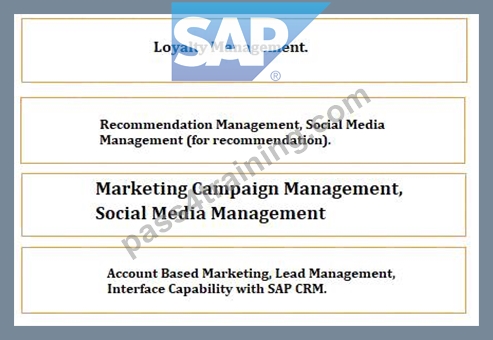
Select the most appropriate sequence of critical Business Capabilities for the Business Architecture Roadmap.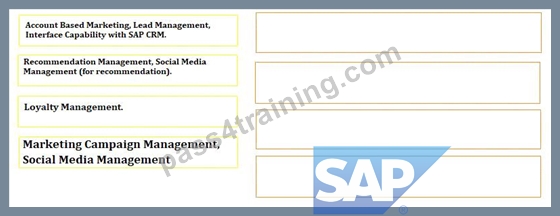
Answer:
Explanation: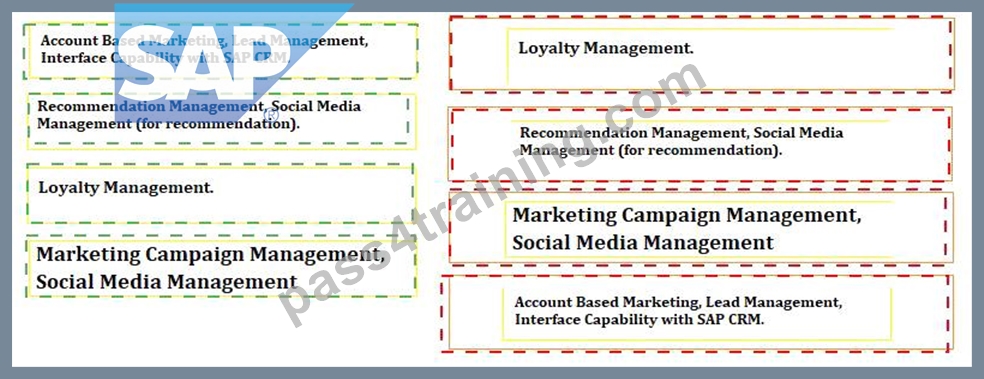
NEW QUESTION # 30
As Chief Enterprise Architect, you want to select an extension option that follows SAP's clean-core strategy. What are your recommendations to implement the clean-core strategy best?
- A. To follow the clean-core strategy, the so-called "Developer Extensibility" of S/4HANA isn't allowed. Extensions must use "Side-by-Side Extensibility" on the SAP Business Technology Platform. These extensions use corresponding public remote APIs of the S/4HANA backend system.
- B. Use of public local APIs or public remote APIs for "Developer Extensibility.
- C. Use "Key User Extensibility" functions of S/4HANA for simple extensions. "Developer Extensibility must comply with the rules for a Tier-1 or Tier-2 extension.
- D. Follow SAP's Tier 1 to Tier 2 extension model, which enables different extension options: Cloud Extensibility Model and Cloud API Enablement. This allows the development of cloud- ready and upgrade-stable applications and extensions.
Answer: A
Explanation:
The clean-core strategy is a SAP initiative to keep the core of SAP S/4HANA as clean as possible by moving customizations and extensions to the side-by-side layer. This allows SAP to more easily deliver new releases of S/4HANA without having to worry about breaking custom code.
There are two main ways to extend SAP S/4HANA:
Developer Extensibility: This allows developers to extend the core of SAP S/4HANA by modifying the source code. This is not allowed under the clean-core strategy.
Side-by-Side Extensibility: This allows developers to extend SAP S/4HANA by creating new applications that run alongside the core system. These applications can communicate with the core system using public APIs.
The following are the benefits of using Side-by-Side Extensibility:
Flexibility: Side-by-Side Extensibility allows developers to extend SAP S/4HANA in any way they see fit.
Scalability: Side-by-Side Extensibility can be scaled to meet the needs of any organization.
Maintainability: Side-by-Side Extensibility is easier to maintain than Developer Extensibility, because custom code is not embedded in the core system.
Therefore, the best way to implement the clean-core strategy is to use Side-by-Side Extensibility. This will allow you to extend SAP S/4HANA in a flexible, scalable, and maintainable way.
NEW QUESTION # 31
For the next Architecture Board meeting, you need to determine the next steps required after the business, application/data and technology architecture designs have been created. What do you recommend?
- A. Establishing change management processes for the management of the business application/data and technology artifacts Handing over the artifacts to the implementation partner and rolling out the project
- B. Finalizing the Business, Application/Data, and Technology Architecture artifacts. Building an Architecture Roadmap. Creating a first draft of the Project/Rollout Project plan.
- C. Reviewing Business Application/Data and Technology Architecture artifacts with stakeholders and signing off on first versions.Using Transition Architectures to build the Architecture Roadmap. Creating first drafts of the required work packages and the Project/Rollout plan.
Answer: C
Explanation:
After the business, application/data, and technology architecture designs have been created, it is vital to engage with stakeholders to review these artifacts and gain their sign-off, ensuring that the designs meet the business requirements and are aligned with the strategic direction of the company. Transition Architectures are an essential part of building the Architecture Roadmap as they provide interim 'target states' that enable the organization to move towards the final architecture in a controlled manner. Creating the initial drafts of the work packages and the project/rollout plan is necessary to commence the detailed planning for implementation.
= This approach is documented within the SAP Enterprise Architecture development process, which underscores the importance of stakeholder engagement, Transition Architectures, and detailed planning for successful EA implementation. Relevant documents include "SAP Enterprise Architecture Framework" and "Transition Architecture Planning in SAP Environments."
NEW QUESTION # 32
Why is it useful to create Transition Architectures in the Application Architecture domain?
- A. They structure complex application architectures that require multiple changes of existing interdependent applications and/or the rollout of new applications. Some applications/solutions depend on the existence of others.
- B. They reduce the total number of solution components in the target state of complex application architectures that require multiple changes of existing applications and/or rollout of new applications. All applications/solutions do NOT depend on the existence of others.
- C. They structure complex application architectures that require multiple changes to existing independent applications and/or the rollout of new applications. Considered applications/solutions do NOT depend on the existence of others.
Answer: A
Explanation:
According to the SAP Enterprise Architecture Framework, which is a methodology and toolset by the German multinational software company SAP that helps enterprise architects define and implement an architecture strategy for their organizations, Transition Architectures are intermediate states between the Baseline Architecture (the current situation) and the Target Architecture (the desired future state). Transition Architectures describe how to move from one state to another in a feasible and manageable way, taking into account the constraints and dependencies of the project. Transition Architectures are useful for structuring complex application architectures that require multiple changes of existing interdependent applications and/or the rollout of new applications. Some applications/solutions depend on the existence of others, meaning that they cannot be implemented or operated without the presence or functionality of other applications/solutions. For example, a new application that relies on data from an existing application, or an existing application that needs to be integrated with a new application. By creating Transition Architectures, enterprise architects can:
Define and prioritize the sequence and timing of the changes and rollouts that are needed to achieve the Target Architecture.
Identify and mitigate the risks and issues that might arise during the transition process, such as technical, operational, or organizational challenges.
Communicate and align with the stakeholders and sponsors of the project, such as business owners, users, developers, vendors, etc.
Monitor and control the progress and performance of the project, and ensure that it meets the requirements and expectations of the project.
Transition Architectures are useful in the Application Architecture domain because they can help to structure complex application architectures that require multiple changes of existing interdependent applications and/or the rollout of new applications.
In some cases, it may be possible to make changes to existing applications independently of each other. However, in many cases, changes to one application will require changes to other applications. This is because applications often depend on each other for data or functionality.
Transition Architectures can help to identify these dependencies and to plan the changes to the applications in a way that minimizes the impact on the business. They can also help to ensure that the changes are made in a consistent and orderly fashion.
The following are some of the benefits of using Transition Architectures in the Application Architecture domain:
They can help to improve the visibility of complex application architectures.
They can help to identify dependencies between applications.
They can help to plan the changes to applications in a way that minimizes the impact on the business.
They can help to ensure that the changes are made in a consistent and orderly fashion.
Therefore, Transition Architectures can be a valuable tool for managing complex application architectures.
NEW QUESTION # 33
Which artifacts does SAP provide as part of the SAP Reference Business Architecture content?
- A. Business Process Model/Solution Process Model
- B. Business Capability Model/Business Data Model/Business Role Model/Product Map
- C. Business Capability Model/Business Process Model
Answer: B
Explanation:
SAP provides a comprehensive set of artifacts as part of its SAP Reference Business Architecture content to support enterprises in designing their business architecture efficiently and effectively. The correct answer, A, encompasses a broad range of these artifacts:
Business Capability Model: Defines the capabilities an organization requires to achieve its business objectives and outcomes.
Business Data Model: Outlines the structure of the data elements within an organization and their relationships.
Business Role Model: Describes roles within the organization and their responsibilities.
Product Map: Provides an overview of the products and services an organization offers and how they relate to business capabilities and processes.
These artifacts are foundational for understanding and designing the enterprise's business architecture, ensuring alignment with strategic goals, technological capabilities, and operational processes.
:
SAP Reference Architecture documentation.
SAP Business Architecture Services.
NEW QUESTION # 34
When creating an application architecture roadmap, the WHAT and WHERE are defined in a rather straightforward way, while the WHOM may differ by context. Multiple roadmap clusters may apply a variety of WHOM dimensions. For example, procurement vs. asset management. Which of the following definitions are correct? Note. There are 3 correct answers to this question.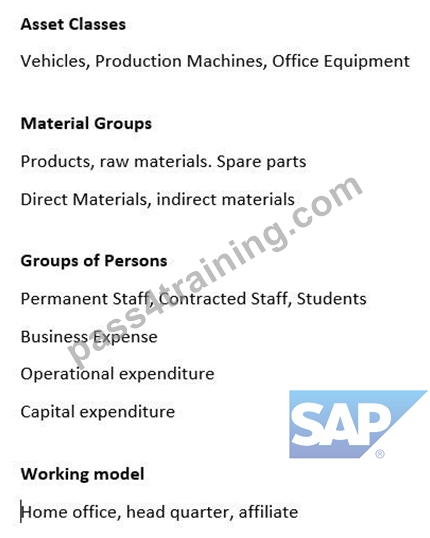
- A. Material Groups/Products, raw materials. Spare parts/Direct Materials, indirect materials
- B. Working model/Home office, head quarter, affiliate
- C. Groups of Persons/Permanent Staff, Contracted Staff, Students/Business Expense/Operational expenditure/Capital expenditure
- D. Asset Classes/Vehicles, Production Machines, Office Equipment
Answer: A,B,C
Explanation:
When creating an application architecture roadmap, the 'WHOM' dimension refers to the stakeholders or entities that will be impacted by or interact with the application. This dimension can vary greatly depending on the context and the specific focus areas of the roadmap. The correct answers that define the 'WHOM' dimension in various contexts are:
B . Material Groups/Products: This refers to the categorization of items such as raw materials, spare parts, direct materials, and indirect materials. These groups are relevant stakeholders in the context of procurement and supply chain management applications.
C . Groups of Persons/Business Expense: This includes different categories of personnel such as permanent staff, contracted staff, and students. It also encompasses different types of expenses like operational expenditure and capital expenditure, which are crucial considerations for financial management and human resource management applications.
D . Working model: This pertains to the various operational models such as home office, headquarters, and affiliates. These models are significant for applications that manage organizational structures, remote work capabilities, and location-based access to resources.
A . Asset Classes/Vehicles is not a correct answer as it describes types of assets rather than stakeholders or entities interacting with the application.
Reference:
SAP. (n.d.). SAP Enterprise Architecture Framework. SAP Community.
The Open Group. (2018). TOGAF Version 9.2: Enterprise Architecture Framework.
International Organization for Standardization. (2015). ISO/IEC/IEEE 42010:2011 - Systems and software engineering - Architecture description.
NEW QUESTION # 35
As a result of solution mapping, business capabilities might require services which partners have implemented in SAP BTP. Which SAP components and services, if any, are required to integrate such BTP partner services with an on-premise SAP S/4HANA system (hybrid scenario)?
- A. No other components are required to make an SAP on-premise backend system securely accessible over SAP BTP SAP BTP automatically establishes secure connections in SAP backend systems.
- B. SAP HANA Cloud Connection, and the corresponding SAP Data Provisioning Agent, to make the on-premises system available to applications and services in a given SAP BTP sub account. Preferably use the SAP BTP Destination Service.
- C. SAP Cloud Connector to make the on-premises system available to applications and services in a given SAP BTP sub account. Preferably use the SAP BTP Destination Service in combination with Cloud Connector.
Answer: C
Explanation:
Explanation
In a hybrid scenario, where business capabilities require services which partners have implemented in SAP BTP and an on-premise SAP S/4HANA system, the following SAP components and services are required to integrate such BTP partner services with the on-premise system:
SAP Cloud Connector: The SAP Cloud Connector is a software component that allows you to connect your on-premise SAP systems to SAP BTP. The Cloud Connector provides a secure connection between your on-premise system and SAP BTP, and it also makes your on-premise system available to applications and services in SAP BTP.
SAP BTP Destination Service: The SAP BTP Destination Service is a service that provides a single point of entry for accessing on-premise systems from SAP BTP. The Destination Service makes it easy to manage and secure connections to on-premise systems, and it also provides a way to federate data from different on-premise systems.
In order to integrate BTP partner services with an on-premise SAP S/4HANA system, you will need to install the SAP Cloud Connector on your on-premise system and register the Cloud Connector with SAP BTP. You will also need to create a destination in the SAP BTP Destination Service for your on-premise system. Once you have done this, you will be able to access the on-premise system from applications and services in SAP BTP.
It is important to note that you can also use other SAP components to integrate on-premise systems with SAP BTP. However, the SAP Cloud Connector and the SAP BTP Destination Service are the most commonly used components for this purpose.
To integrate BTP partner services with an on-premise SAP S/4HANA system, you need to use the SAP Cloud Connector, which is a reverse proxy that establishes a secure connection between your on-premise system and your SAP BTP subaccount5. The Cloud Connector acts as a bridge between your on-premise network and a trusted subaccount on SAP BTP6. It allows you to access resources in your on-premise network from applications running on SAP BTP without exposing your internal landscape to the internet7.
To simplify the configuration and consumption of the Cloud Connector connection, you can use the SAP BTP Destination Service, which is a service that allows you to define and manage destinations for accessing remote systems from applications running on SAP BTP8. A destination is a set of properties that contains information such as the URL, authentication method, proxy type, and additional parameters of a remote system9. By using the Destination Service, you can centrally manage and securely store the connection details of your on-premise system and consume them from your BTP partner services.
Verified References: 5:
https://help.sap.com/viewer/cca91383641e40ffbe03bdc78f00f681/Cloud/en-US/e6c7616abb5710148cfcf3e75d96
| 6:
https://help.sap.com/viewer/cca91383641e40ffbe03bdc78f00f681/Cloud/en-US/8d3b28a7c1644a1c9d1ee165ec0
| 7:
https://help.sap.com/viewer/cca91383641e40ffbe03bdc78f00f681/Cloud/en-US/e54cc8fbbb571014a4d9e7f02f9f
| 8:
https://help.sap.com/viewer/cca91383641e40ffbe03bdc78f00f681/Cloud/en-US/3cb7b81115c44cf594e0e363129
| 9:
https://help.sap.com/viewer/cca91383641e40ffbe03bdc78f00f681/Cloud/en-US/e54f70d327154aa0a4ba36ce7ac4
NEW QUESTION # 36
......
Valid P_SAPEA_2023 Test Answers & SAP P_SAPEA_2023 Exam PDF: https://www.pass4training.com/P_SAPEA_2023-pass-exam-training.html
Realistic P_SAPEA_2023 Exam Dumps with Accurate & Updated Questions: https://drive.google.com/open?id=1u28cg05c0A9KJbgLBRs6xg7EYlD4l---
