

Practice Generative AI Engineer Databricks-Generative-AI-Engineer-Associate exam. Online Exam Practice Tests with detailed explanations! Pass Databricks-Generative-AI-Engineer-Associate with confidence!
Databricks-Generative-AI-Engineer-Associate - Databricks Certified Generative AI Engineer Associate Practice Tests 2026 | Pass4training
NEW QUESTION # 41
A Generative AI Engineer I using the code below to test setting up a vector store: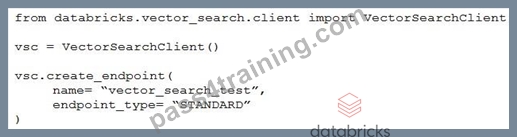
Assuming they intend to use Databricks managed embeddings with the default embedding model, what should be the next logical function call?
- A. vsc.create_delta_sync_index()
- B. vsc.similarity_search()
- C. vsc.create_direct_access_index()
- D. vsc.get_index()
Answer: A
Explanation:
* Context: The Generative AI Engineer is setting up a vector store using Databricks' VectorSearchClient. This is typically done to enable fast and efficient retrieval of vectorized data for tasks like similarity searches.
* Explanation of Options:
Option A: vsc.get_index(): This function would be used to retrieve an existing index, not create one, so it would not be the logical next step immediately after creating an endpoint.
Option B: vsc.create_delta_sync_index(): After setting up a vector store endpoint, creating an index is necessary to start populating and organizing the data. The create_delta_sync_index() function specifically creates an index that synchronizes with a Delta table, allowing automatic updates as the data changes. This is likely the most appropriate choice if the engineer plans to use dynamic data that is updated over time.
Option C: vsc.create_direct_access_index(): This function would create an index that directly accesses the data without synchronization. While also a valid approach, it's less likely to be the next logical step if the default setup (typically accommodating changes) is intended.
Option D: vsc.similarity_search(): This function would be used to perform searches on an existing index; however, an index needs to be created and populated with data before any search can be conducted.
Given the typical workflow in setting up a vector store, the next step after creating an endpoint is to establish an index, particularly one that synchronizes with ongoing data updates, hence Option B.
NEW QUESTION # 42
A Generative Al Engineer needs to design an LLM pipeline to conduct multi-stage reasoning that leverages external tools. To be effective at this, the LLM will need to plan and adapt actions while performing complex reasoning tasks.
Which approach will do this?
- A. Tram the LLM to generate a single, comprehensive response without interacting with any external tools, relying solely on its pre-trained knowledge.
- B. Implement a framework like ReAct which allows the LLM to generate reasoning traces and perform task-specific actions that leverage external tools if necessary.
- C. Encourage the LLM to make multiple API calls in sequence without planning or structuring the calls, allowing the LLM to decide when and how to use external tools spontaneously.
- D. Use a Chain-of-Thought (CoT) prompting technique to guide the LLM through a series of reasoning steps, then manually input the results from external tools for the final answer.
Answer: B
Explanation:
The task requires an LLM pipeline for multi-stage reasoning with external tools, necessitating planning, adaptability, and complex reasoning. Let's evaluate the options based on Databricks' recommendations for advanced LLM workflows.
Option A: Train the LLM to generate a single, comprehensive response without interacting with any external tools, relying solely on its pre-trained knowledge This approach limits the LLM to its static knowledge base, excluding external tools and multi-stage reasoning. It can't adapt or plan actions dynamically, failing the requirements.
Databricks Reference: "External tools enhance LLM capabilities beyond pre-trained knowledge" ("Building LLM Applications with Databricks," 2023).
Option B: Implement a framework like ReAct which allows the LLM to generate reasoning traces and perform task-specific actions that leverage external tools if necessary ReAct (Reasoning + Acting) combines reasoning traces (step-by-step logic) with actions (e.g., tool calls), enabling the LLM to plan, adapt, and execute complex tasks iteratively. This meets all requirements: multi-stage reasoning, tool use, and adaptability.
Databricks Reference: "Frameworks like ReAct enable LLMs to interleave reasoning and external tool interactions for complex problem-solving" ("Generative AI Cookbook," 2023).
Option C: Encourage the LLM to make multiple API calls in sequence without planning or structuring the calls, allowing the LLM to decide when and how to use external tools spontaneously Unstructured, spontaneous API calls lack planning and may lead to inefficient or incorrect tool usage. This doesn't ensure effective multi-stage reasoning or adaptability.
Databricks Reference: Structured frameworks are preferred: "Ad-hoc tool calls can reduce reliability in complex tasks" ("Building LLM-Powered Applications").
Option D: Use a Chain-of-Thought (CoT) prompting technique to guide the LLM through a series of reasoning steps, then manually input the results from external tools for the final answer CoT improves reasoning but relies on manual tool interaction, breaking automation and adaptability. It's not a scalable pipeline solution.
Databricks Reference: "Manual intervention is impractical for production LLM pipelines" ("Databricks Generative AI Engineer Guide").
Conclusion: Option B (ReAct) is the best approach, as it integrates reasoning and tool use in a structured, adaptive framework, aligning with Databricks' guidance for complex LLM workflows.
NEW QUESTION # 43
A Generative Al Engineer is building a system which will answer questions on latest stock news articles.
Which will NOT help with ensuring the outputs are relevant to financial news?
- A. Implement a comprehensive guardrail framework that includes policies for content filters tailored to the finance sector.
- B. Increase the compute to improve processing speed of questions to allow greater relevancy analysis C Implement a profanity filter to screen out offensive language
- C. Incorporate manual reviews to correct any problematic outputs prior to sending to the users
Answer: B
Explanation:
In the context of ensuring that outputs are relevant to financial news, increasing compute power (option B) does not directly improve the relevance of the LLM-generated outputs. Here's why:
Compute Power and Relevancy:
Increasing compute power can help the model process inputs faster, but it does not inherently improve the relevance of the answers. Relevancy depends on the data sources, the retrieval method, and the filtering mechanisms in place, not on how quickly the model processes the query.
What Actually Helps with Relevance:
Other methods, like content filtering, guardrails, or manual review, can directly impact the relevance of the model's responses by ensuring the model focuses on pertinent financial content. These methods help tailor the LLM's responses to the financial domain and avoid irrelevant or harmful outputs.
Why Other Options Are More Relevant:
A (Comprehensive Guardrail Framework): This will ensure that the model avoids generating content that is irrelevant or inappropriate in the finance sector.
C (Profanity Filter): While not directly related to financial relevancy, ensuring the output is clean and professional is still important in maintaining the quality of responses.
D (Manual Review): Incorporating human oversight to catch and correct issues with the LLM's output ensures the final answers are aligned with financial content expectations.
Thus, increasing compute power does not help with ensuring the outputs are more relevant to financial news, making option B the correct answer.
NEW QUESTION # 44
A Generative Al Engineer is helping a cinema extend its website's chat bot to be able to respond to questions about specific showtimes for movies currently playing at their local theater. They already have the location of the user provided by location services to their agent, and a Delta table which is continually updated with the latest showtime information by location. They want to implement this new capability In their RAG application.
Which option will do this with the least effort and in the most performant way?
- A. Create a Feature Serving Endpoint from a FeatureSpec that references an online store synced from the Delta table. Query the Feature Serving Endpoint as part of the agent logic / tool implementation.
- B. implementation. Write the Delta table contents to a text column.then embed those texts using an embedding model and store these in the vector index Look up the information based on the embedding as part of the agent logic / tool implementation.
- C. Set up a task in Databricks Workflows to write the information in the Delta table periodically to an external database such as MySQL and query the information from there as part of the agent logic / tool implementation.
- D. Query the Delta table directly via a SQL query constructed from the user's input using a text-to-SQL LLM in the agent logic / tool
Answer: A
Explanation:
The task is to extend a cinema chatbot to provide movie showtime information using a RAG application, leveraging user location and a continuously updated Delta table, with minimal effort and high performance. Let's evaluate the options.
Option A: Create a Feature Serving Endpoint from a FeatureSpec that references an online store synced from the Delta table. Query the Feature Serving Endpoint as part of the agent logic / tool implementation Databricks Feature Serving provides low-latency access to real-time data from Delta tables via an online store. Syncing the Delta table to a Feature Serving Endpoint allows the chatbot to query showtimes efficiently, integrating seamlessly into the RAG agent's tool logic. This leverages Databricks' native infrastructure, minimizing effort and ensuring performance.
Databricks Reference: "Feature Serving Endpoints provide real-time access to Delta table data with low latency, ideal for production systems" ("Databricks Feature Engineering Guide," 2023).
Option B: Query the Delta table directly via a SQL query constructed from the user's input using a text-to-SQL LLM in the agent logic / tool Using a text-to-SQL LLM to generate queries adds complexity (e.g., ensuring accurate SQL generation) and latency (LLM inference + SQL execution). While feasible, it's less performant and requires more effort than a pre-built serving solution.
Databricks Reference: "Direct SQL queries are flexible but may introduce overhead in real-time applications" ("Building LLM Applications with Databricks").
Option C: Write the Delta table contents to a text column, then embed those texts using an embedding model and store these in the vector index. Look up the information based on the embedding as part of the agent logic / tool implementation Converting structured Delta table data (e.g., showtimes) into text, embedding it, and using vector search is inefficient for structured lookups. It's effort-intensive (preprocessing, embedding) and less precise than direct queries, undermining performance.
Databricks Reference: "Vector search excels for unstructured data, not structured tabular lookups" ("Databricks Vector Search Documentation").
Option D: Set up a task in Databricks Workflows to write the information in the Delta table periodically to an external database such as MySQL and query the information from there as part of the agent logic / tool implementation Exporting to an external database (e.g., MySQL) adds setup effort (workflow, external DB management) and latency (periodic updates vs. real-time). It's less performant and more complex than using Databricks' native tools.
Databricks Reference: "Avoid external systems when Delta tables provide real-time data natively" ("Databricks Workflows Guide").
Conclusion: Option A minimizes effort by using Databricks Feature Serving for real-time, low-latency access to the Delta table, ensuring high performance in a production-ready RAG chatbot.
NEW QUESTION # 45
A Generative Al Engineer needs to design an LLM pipeline to conduct multi-stage reasoning that leverages external tools. To be effective at this, the LLM will need to plan and adapt actions while performing complex reasoning tasks.
Which approach will do this?
- A. Tram the LLM to generate a single, comprehensive response without interacting with any external tools, relying solely on its pre-trained knowledge.
- B. Implement a framework like ReAct which allows the LLM to generate reasoning traces and perform task-specific actions that leverage external tools if necessary.
- C. Encourage the LLM to make multiple API calls in sequence without planning or structuring the calls, allowing the LLM to decide when and how to use external tools spontaneously.
- D. Use a Chain-of-Thought (CoT) prompting technique to guide the LLM through a series of reasoning steps, then manually input the results from external tools for the final answer.
Answer: B
Explanation:
The task requires an LLM pipeline for multi-stage reasoning with external tools, necessitating planning, adaptability, and complex reasoning. Let's evaluate the options based on Databricks' recommendations for advanced LLM workflows.
* Option A: Train the LLM to generate a single, comprehensive response without interacting with any external tools, relying solely on its pre-trained knowledge
* This approach limits the LLM to its static knowledge base, excluding external tools and multi- stage reasoning. It can't adapt or plan actions dynamically, failing the requirements.
* Databricks Reference:"External tools enhance LLM capabilities beyond pre-trained knowledge" ("Building LLM Applications with Databricks," 2023).
* Option B: Implement a framework like ReAct which allows the LLM to generate reasoning traces and perform task-specific actions that leverage external tools if necessary
* ReAct (Reasoning + Acting) combines reasoning traces (step-by-step logic) with actions (e.g., tool calls), enabling the LLM to plan, adapt, and execute complex tasks iteratively. This meets all requirements: multi-stage reasoning, tool use, and adaptability.
* Databricks Reference:"Frameworks like ReAct enable LLMs to interleave reasoning and external tool interactions for complex problem-solving"("Generative AI Cookbook," 2023).
* Option C: Encourage the LLM to make multiple API calls in sequence without planning or structuring the calls, allowing the LLM to decide when and how to use external tools spontaneously
* Unstructured, spontaneous API calls lack planning and may lead to inefficient or incorrect tool usage. This doesn't ensure effective multi-stage reasoning or adaptability.
* Databricks Reference: Structured frameworks are preferred:"Ad-hoc tool calls can reduce reliability in complex tasks"("Building LLM-Powered Applications").
* Option D: Use a Chain-of-Thought (CoT) prompting technique to guide the LLM through a series of reasoning steps, then manually input the results from external tools for the final answer
* CoT improves reasoning but relies on manual tool interaction, breaking automation and adaptability. It's not a scalable pipeline solution.
* Databricks Reference:"Manual intervention is impractical for production LLM pipelines" ("Databricks Generative AI Engineer Guide").
Conclusion: Option B (ReAct) is the best approach, as it integrates reasoning and tool use in a structured, adaptive framework, aligning with Databricks' guidance for complex LLM workflows.
NEW QUESTION # 46
A team wants to serve a code generation model as an assistant for their software developers. It should support multiple programming languages. Quality is the primary objective.
Which of the Databricks Foundation Model APIs, or models available in the Marketplace, would be the best fit?
- A. BGE-large
- B. CodeLlama-34B
- C. MPT-7b
- D. Llama2-70b
Answer: B
Explanation:
For a code generation model that supports multiple programming languages and where quality is the primary objective, CodeLlama-34B is the most suitable choice. Here's the reasoning:
Specialization in Code Generation:
CodeLlama-34B is specifically designed for code generation tasks. This model has been trained with a focus on understanding and generating code, which makes it particularly adept at handling various programming languages and coding contexts.
Capacity and Performance:
The "34B" indicates a model size of 34 billion parameters, suggesting a high capacity for handling complex tasks and generating high-quality outputs. The large model size typically correlates with better understanding and generation capabilities in diverse scenarios.
Suitability for Development Teams:
Given that the model is optimized for code, it will be able to assist software developers more effectively than general-purpose models. It understands coding syntax, semantics, and the nuances of different programming languages.
Why Other Options Are Less Suitable:
A (Llama2-70b): While also a large model, it's more general-purpose and may not be as fine-tuned for code generation as CodeLlama.
B (BGE-large): This model may not specifically focus on code generation.
C (MPT-7b): Smaller than CodeLlama-34B and likely less capable in handling complex code generation tasks at high quality.
Therefore, for a high-quality, multi-language code generation application, CodeLlama-34B (option D) is the best fit.
NEW QUESTION # 47
A Generative AI Engineer is building a Generative AI system that suggests the best matched employee team member to newly scoped projects. The team member is selected from a very large team. Thematch should be based upon project date availability and how well their employee profile matches the project scope. Both the employee profile and project scope are unstructured text.
How should the Generative Al Engineer architect their system?
- A. Create a tool to find available team members given project dates. Create a second tool that can calculate a similarity score for a combination of team member profile and the project scope. Iterate through the team members and rank by best score to select a team member.
- B. Create a tool for finding team member availability given project dates, and another tool that uses an LLM to extract keywords from project scopes. Iterate through available team members' profiles and perform keyword matching to find the best available team member.
- C. Create a tool for finding available team members given project dates. Embed team profiles into a vector store and use the project scope and filtering to perform retrieval to find the available best matched team members.
- D. Create a tool for finding available team members given project dates. Embed all project scopes into a vector store, perform a retrieval using team member profiles to find the best team member.
Answer: C
NEW QUESTION # 48
A Generative Al Engineer would like an LLM to generate formatted JSON from emails. This will require parsing and extracting the following information: order ID, date, and sender email. Here's a sample email: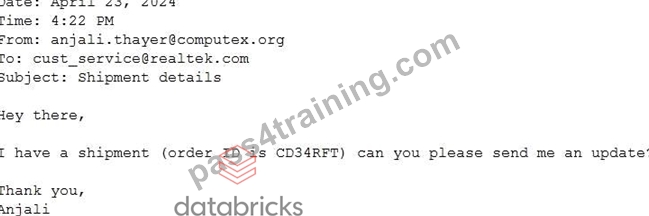
They will need to write a prompt that will extract the relevant information in JSON format with the highest level of output accuracy.
Which prompt will do that?
- A. You will receive customer emails and need to extract date, sender email, and order ID. You should return the date, sender email, and order ID information in JSON format.
- B. You will receive customer emails and need to extract date, sender email, and order ID. Return the extracted information in JSON format.
Here's an example: {"date": "April 16, 2024", "sender_email": "[email protected]", "order_id":
"RE987D"} - C. You will receive customer emails and need to extract date, sender email, and order ID. Return the extracted information in JSON format.
- D. You will receive customer emails and need to extract date, sender email, and order ID. Return the extracted information in a human-readable format.
Answer: B
Explanation:
Problem Context: The goal is to parse emails to extract certain pieces of information and output this in a structured JSON format. Clarity and specificity in the prompt design will ensure higher accuracy in the LLM' s responses.
Explanation of Options:
* Option A: Provides a general guideline but lacks an example, which helps an LLM understand the exact format expected.
* Option B: Includes a clear instruction and a specific example of the output format. Providing an example is crucial as it helps set the pattern and format in which the information should be structured, leading to more accurate results.
* Option C: Does not specify that the output should be in JSON format, thus not meeting the requirement.
* Option D: While it correctly asks for JSON format, it lacks an example that would guide the LLM on how to structure the JSON correctly.
Therefore,Option Bis optimal as it not only specifies the required format but also illustrates it with an example, enhancing the likelihood of accurate extraction and formatting by the LLM.
NEW QUESTION # 49
Which TWO chain components are required for building a basic LLM-enabled chat application that includes conversational capabilities, knowledge retrieval, and contextual memory?
- A. Conversation Buffer Memory
- B. Chat loaders
- C. External tools
- D. Vector Stores
- E. React Components
- F. (Q)
Answer: A,D
Explanation:
Building a basic LLM-enabled chat application with conversational capabilities, knowledge retrieval, and contextual memory requires specific components that work together to process queries, maintain context, and retrieve relevant information. Databricks' Generative AI Engineer documentation outlines key components for such systems, particularly in the context of frameworks like LangChain or Databricks' MosaicML integrations. Let's evaluate the required components:
* Understanding the Requirements:
* Conversational capabilities: The app must generate natural, coherent responses.
* Knowledge retrieval: It must access external or domain-specific knowledge.
* Contextual memory: It must remember prior interactions in the conversation.
* Databricks Reference:"A typical LLM chat application includes a memory component to track conversation history and a retrieval mechanism to incorporate external knowledge"("Databricks Generative AI Cookbook," 2023).
* Evaluating the Options:
* A. (Q): This appears incomplete or unclear (possibly a typo). Without further context, it's not a valid component.
* B. Vector Stores: These store embeddings of documents or knowledge bases, enabling semantic search and retrieval of relevant information for the LLM. This is critical for knowledge retrieval in a chat application.
* Databricks Reference:"Vector stores, such as those integrated with Databricks' Lakehouse, enable efficient retrieval of contextual data for LLMs"("Building LLM Applications with Databricks").
* C. Conversation Buffer Memory: This component stores the conversation history, allowing the LLM to maintain context across multiple turns. It's essential for contextual memory.
* Databricks Reference:"Conversation Buffer Memory tracks prior user inputs and LLM outputs, ensuring context-aware responses"("Generative AI Engineer Guide").
* D. External tools: These (e.g., APIs or calculators) enhance functionality but aren't required for a basicchat app with the specified capabilities.
* E. Chat loaders: These might refer to data loaders for chat logs, but they're not a core chain component for conversational functionality or memory.
* F. React Components: These relate to front-end UI development, not the LLM chain's backend functionality.
* Selecting the Two Required Components:
* Forknowledge retrieval, Vector Stores (B) are necessary to fetch relevant external data, a cornerstone of Databricks' RAG-based chat systems.
* Forcontextual memory, Conversation Buffer Memory (C) is required to maintain conversation history, ensuring coherent and context-aware responses.
* While an LLM itself is implied as the core generator, the question asks for chain components beyond the model, making B and C the minimal yet sufficient pair for a basic application.
Conclusion: The two required chain components areB. Vector StoresandC. Conversation Buffer Memory, as they directly address knowledge retrieval and contextual memory, respectively, aligning with Databricks' documented best practices for LLM-enabled chat applications.
NEW QUESTION # 50
A Generative Al Engineer is using an LLM to classify species of edible mushrooms based on text descriptions of certain features. The model is returning accurate responses in testing and the Generative Al Engineer is confident they have the correct list of possible labels, but the output frequently contains additional reasoning in the answer when the Generative Al Engineer only wants to return the label with no additional text.
Which action should they take to elicit the desired behavior from this LLM?
- A. Use zero shot prompting to instruct the model on expected output format
- B. Use few snot prompting to instruct the model on expected output format
- C. Use zero shot chain-of-thought prompting to prevent a verbose output format
- D. Use a system prompt to instruct the model to be succinct in its answer
Answer: D
Explanation:
The LLM classifies mushroom species accurately but includes unwanted reasoning text, and the engineer wants only the label. Let's assess how to control output format effectively.
Option A: Use few shot prompting to instruct the model on expected output format Few-shot prompting provides examples (e.g., input: description, output: label). It can work but requires crafting multiple examples, which is effort-intensive and less direct than a clear instruction.
Databricks Reference: "Few-shot prompting guides LLMs via examples, effective for format control but requires careful design" ("Generative AI Cookbook").
Option B: Use zero shot prompting to instruct the model on expected output format Zero-shot prompting relies on a single instruction (e.g., "Return only the label") without examples. It's simpler than few-shot but may not consistently enforce succinctness if the LLM's default behavior is verbose.
Databricks Reference: "Zero-shot prompting can specify output but may lack precision without examples" ("Building LLM Applications with Databricks").
Option C: Use zero shot chain-of-thought prompting to prevent a verbose output format Chain-of-Thought (CoT) encourages step-by-step reasoning, which increases verbosity-opposite to the desired outcome. This contradicts the goal of label-only output.
Databricks Reference: "CoT prompting enhances reasoning but often results in detailed responses" ("Databricks Generative AI Engineer Guide").
Option D: Use a system prompt to instruct the model to be succinct in its answer A system prompt (e.g., "Respond with only the species label, no additional text") sets a global instruction for the LLM's behavior. It's direct, reusable, and effective for controlling output style across queries.
Databricks Reference: "System prompts define LLM behavior consistently, ideal for enforcing concise outputs" ("Generative AI Cookbook," 2023).
Conclusion: Option D is the most effective and straightforward action, using a system prompt to enforce succinct, label-only responses, aligning with Databricks' best practices for output control.
NEW QUESTION # 51
A Generative AI Engineer has a provisioned throughput model serving endpoint as part of a RAG application and would like to monitor the serving endpoint's incoming requests and outgoing responses. The current approach is to include a micro-service in between the endpoint and the user interface to write logs to a remote server.
Which Databricks feature should they use instead which will perform the same task?
- A. Lakeview
- B. Vector Search
- C. Inference Tables
- D. DBSQL
Answer: C
Explanation:
Problem Context: The goal is to monitor theserving endpointfor incoming requests and outgoing responses in aprovisioned throughput model serving endpointwithin aRetrieval-Augmented Generation (RAG) application. The current approach involves using a microservice to log requests and responses to a remote server, but the Generative AI Engineer is looking for a more streamlined solution within Databricks.
Explanation of Options:
* Option A: Vector Search: This feature is used to perform similarity searches within vector databases.
It doesn't provide functionality for logging or monitoring requests and responses in a serving endpoint, so it's not applicable here.
* Option B: Lakeview: Lakeview is not a feature relevant to monitoring or logging request-response cycles for serving endpoints. It might be more related to viewing data in Databricks Lakehouse but doesn't fulfill the specific monitoring requirement.
* Option C: DBSQL: Databricks SQL (DBSQL) is used for running SQL queries on data stored in Databricks, primarily for analytics purposes. It doesn't provide the direct functionality needed to monitor requests and responses in real-time for an inference endpoint.
* Option D: Inference Tables: This is the correct answer.Inference Tablesin Databricks are designed to store the results and metadata of inference runs. This allows the system to logincoming requests and outgoing responsesdirectly within Databricks, making it an ideal choice for monitoring the behavior of a provisioned serving endpoint. Inference Tables can be queried and analyzed, enabling easier monitoring and debugging compared to a custom microservice.
Thus,Inference Tablesare the optimal feature for monitoring request and response logs within the Databricks infrastructure for a model serving endpoint.
NEW QUESTION # 52
A Generative AI Engineer is using LangGraph to define multiple tools in a single agentic application. They want to enable the main orchestrator LLM to decide on its own which tools are most appropriate to call for a given prompt. To do this, they must determine the general flow of the code. Which sequence will do this?
- A. 1. Define the tools inside the agents 2. Load the agents into the LLM 3. Instruct the LLM to use COT reasoning to determine the appropriate agent
- B. 1. Define or import the tools 2. Add tools and LLM to the agent 3. Create the ReAct agent
- C. 1. Define or import the tools 2. Define the agent 3. Initialize the agent with ReAct, the LLM, and the tools
- D. 1. Define the tools 2. Load each tool into a separate agent 3. Instruct the LLM to use ReAct to call the appropriate agent
Answer: C
Explanation:
In modern agentic frameworks like LangGraph or LangChain, the standard workflow for creating an autonomous tool-calling agent follows a specific sequence. First, tools must be defined (often as Python functions with clear docstrings, which the LLM uses to understand the tool's purpose). Second, the agent logic is defined, which specifies how the LLM should think. Third, the agent is initialized using a logic pattern like ReAct (Reason + Act). The ReAct framework is essential here because it enables the "orchestrator" loop: the LLM receives a prompt, generates a "Thought" about which tool to use, generates an "Action" to call that tool, receives an "Observation" (the tool's output), and repeats until it can provide a final answer. Loading tools into "separate agents" (C) or defining tools "inside" agents (D) are non-standard patterns that add unnecessary complexity and do not align with the centralized orchestration model required for LangGraph.
NEW QUESTION # 53
After changing the response generating LLM in a RAG pipeline from GPT-4 to a model with a shorter context length that the company self-hosts, the Generative AI Engineer is getting the following error:
What TWO solutions should the Generative AI Engineer implement without changing the response generating model? (Choose two.)
- A. Decrease the chunk size of embedded documents
- B. Reduce the number of records retrieved from the vector database
- C. Use a smaller embedding model to generate
- D. Retrain the response generating model using ALiBi
- E. Reduce the maximum output tokens of the new model
Answer: A,B
Explanation:
* Problem Context: After switching to a model with a shorter context length, the error message indicating that the prompt token count has exceeded the limit suggests that the input to the model is too large.
* Explanation of Options:
* Option A: Use a smaller embedding model to generate- This wouldn't necessarily address the issue of prompt size exceeding the model's token limit.
* Option B: Reduce the maximum output tokens of the new model- This option affects the output length, not the size of the input being too large.
* Option C: Decrease the chunk size of embedded documents- This would help reduce the size of each document chunk fed into the model, ensuring that the input remains within the model's context length limitations.
* Option D: Reduce the number of records retrieved from the vector database- By retrieving fewer records, the total input size to the model can be managed more effectively, keeping it within the allowable token limits.
* Option E: Retrain the response generating model using ALiBi- Retraining the model is contrary to the stipulation not to change the response generating model.
OptionsCandDare the most effective solutions to manage the model's shorter context length without changing the model itself, by adjusting the input size both in terms of individual document size and total documents retrieved.
NEW QUESTION # 54
A Generative Al Engineer is working with a retail company that wants to enhance its customer experience by automatically handling common customer inquiries. They are working on an LLM-powered Al solution that should improve response times while maintaining a personalized interaction. They want to define the appropriate input and LLM task to do this.
Which input/output pair will do this?
- A. Input: Customer reviews; Output Group the reviews by users and aggregate per-user average rating, then respond
- B. Input: Customer service chat logs; Output Group the chat logs by users, followed by summarizing each user's interactions, then respond
- C. Input: Customer reviews: Output Classify review sentiment
- D. Input: Customer service chat logs; Output: Find the answers to similar questions and respond with a summary
Answer: D
Explanation:
The task described in the question involves enhancing customer experience by automatically handling common customer inquiries using an LLM-powered AI solution. This requires the system to process input data (customer inquiries) and generate personalized, relevant responses efficiently. Let's evaluate the options step-by-step in the context of Databricks Generative AI Engineer principles, which emphasize leveraging LLMs for tasks like question answering, summarization, and retrieval-augmented generation (RAG).
Option A: Input: Customer reviews; Output: Group the reviews by users and aggregate per-user average rating, then respond This option focuses on analyzing customer reviews to compute average ratings per user. While this might be useful for sentiment analysis or user profiling, it does not directly address the goal of handling common customer inquiries or improving response times for personalized interactions. Customer reviews are typically feedback data, not real-time inquiries requiring immediate responses.
Databricks Reference: Databricks documentation on LLMs (e.g., "Building LLM Applications with Databricks") emphasizes that LLMs excel at tasks like question answering and conversational responses, not just aggregation or statistical analysis of reviews.
Option B: Input: Customer service chat logs; Output: Group the chat logs by users, followed by summarizing each user's interactions, then respond This option uses chat logs as input, which aligns with customer service scenarios. However, the output-grouping by users and summarizing interactions-focuses on user-specific summaries rather than directly addressing inquiries. While summarization is an LLM capability, this approach lacks the specificity of finding answers to common questions, which is central to the problem.
Databricks Reference: Per Databricks' "Generative AI Cookbook," LLMs can summarize text, but for customer service, the emphasis is on retrieval and response generation (e.g., RAG workflows) rather than user interaction summaries alone.
Option C: Input: Customer service chat logs; Output: Find the answers to similar questions and respond with a summary This option uses chat logs (real customer inquiries) as input and tasks the LLM with identifying answers to similar questions, then providing a summarized response. This directly aligns with the goal of handling common inquiries efficiently while maintaining personalization (by referencing past interactions or similar cases). It leverages LLM capabilities like semantic search, retrieval, and response generation, which are core to Databricks' LLM workflows.
Databricks Reference: From Databricks documentation ("Building LLM-Powered Applications," 2023), an exact extract states: "For customer support use cases, LLMs can be used to retrieve relevant answers from historical data like chat logs and generate concise, contextually appropriate responses." This matches Option C's approach of finding answers and summarizing them.
Option D: Input: Customer reviews; Output: Classify review sentiment
This option focuses on sentiment classification of reviews, which is a valid LLM task but unrelated to handling customer inquiries or improving response times in a conversational context. It's more suited for feedback analysis than real-time customer service.
Databricks Reference: Databricks' "Generative AI Engineer Guide" notes that sentiment analysis is a common LLM task, but it's not highlighted for real-time conversational applications like customer support.
Conclusion: Option C is the best fit because it uses relevant input (chat logs) and defines an LLM task (finding answers and summarizing) that meets the requirements of improving response times and maintaining personalized interaction. This aligns with Databricks' recommended practices for LLM-powered customer service solutions, such as retrieval-augmented generation (RAG) workflows.
NEW QUESTION # 55
A Generative AI Engineer is experimenting with using parameters to configure an agent in Mosaic Agent Framework. However, they are struggling to get the agent to respond with relevant information with this configuration:
config = {"prompt_template": "You are a trivia bot. Generate a question based on the user's input: {user_input}", "input_vars": ["user_input"], "parameters": {"temperature": 0.01, "max_tokens": 500}} Which error is causing the problem?
- A. The prompt is not wrapped in ChatModel
- B. The prompt does not set the retriever schema
- C. The prompt does not parse the user's input vars
- D. The prompt does not list available agents for the LLM to call
Answer: C
Explanation:
In the Mosaic AI Agent Framework and underlying LangChain-based configurations, the "input_vars" or "input_variables" must be correctly mapped and referenced within the template. If the configuration dictionary identifies user_input as the variable but the logic executing the chain does not correctly "inject" the runtime value into the {user_input} placeholder, the LLM will receive a literal string (or an empty value) rather than the user's actual question. This results in the model failing to provide relevant information because it essentially doesn't know what the user asked. Engineering standards require ensuring that the key used in the input_vars list matches the key in the JSON payload sent to the model serving endpoint. If there is a mismatch or a failure to parse, the prompt remains static, leading to generic or irrelevant responses.
NEW QUESTION # 56
A Generative Al Engineer is building a system that will answer questions on currently unfolding news topics. As such, it pulls information from a variety of sources including articles and social media posts. They are concerned about toxic posts on social media causing toxic outputs from their system.
Which guardrail will limit toxic outputs?
- A. Implement rate limiting
- B. Log all LLM system responses and perform a batch toxicity analysis monthly.
- C. Use only approved social media and news accounts to prevent unexpected toxic data from getting to the LLM.
- D. Reduce the amount of context Items the system will Include in consideration for its response.
Answer: C
Explanation:
The system answers questions on unfolding news topics using articles and social media, with a concern about toxic outputs from toxic inputs. A guardrail must limit toxicity in the LLM's responses. Let's evaluate the options.
Option A: Use only approved social media and news accounts to prevent unexpected toxic data from getting to the LLM Curating input sources (e.g., verified accounts) reduces exposure to toxic content at the data ingestion stage, directly limiting toxic outputs. This is a proactive guardrail aligned with data quality control.
Databricks Reference: "Control input data quality to mitigate unwanted LLM behavior, such as toxicity" ("Building LLM Applications with Databricks," 2023).
Option B: Implement rate limiting
Rate limiting controls request frequency, not content quality. It prevents overload but doesn't address toxicity in social media inputs or outputs.
Databricks Reference: Rate limiting is for performance, not safety: "Use rate limits to manage compute load" ("Generative AI Cookbook").
Option C: Reduce the amount of context items the system will include in consideration for its response Reducing context might limit exposure to some toxic items but risks losing relevant information, and it doesn't specifically target toxicity. It's an indirect, imprecise fix.
Databricks Reference: Context reduction is for efficiency, not safety: "Adjust context size based on performance needs" ("Databricks Generative AI Engineer Guide").
Option D: Log all LLM system responses and perform a batch toxicity analysis monthly Logging and analyzing responses is reactive, identifying toxicity after it occurs rather than preventing it. Monthly analysis doesn't limit real-time toxic outputs.
Databricks Reference: Monitoring is for auditing, not prevention: "Log outputs for post-hoc analysis, but use input filters for safety" ("Building LLM-Powered Applications").
Conclusion: Option A is the most effective guardrail, proactively filtering toxic inputs from unverified sources, which aligns with Databricks' emphasis on data quality as a primary safety mechanism for LLM systems.
NEW QUESTION # 57
A Generative Al Engineer has built an LLM-based system that will automatically translate user text between two languages. They now want to benchmark multiple LLM's on this task and pick the best one. They have an evaluation set with known high quality translation examples. They want to evaluate each LLM using the evaluation set with a performant metric.
Which metric should they choose for this evaluation?
- A. RECALL metric
- B. BLEU metric
- C. ROUGE metric
- D. NDCG metric
Answer: B
Explanation:
The task is to benchmark LLMs for text translation using an evaluation set with known high-quality examples, requiring a performant metric. Let's evaluate the options.
Option A: ROUGE metric
ROUGE (Recall-Oriented Understudy for Gisting Evaluation) measures overlap between generated and reference texts, primarily for summarization. It's less suited for translation, where precision and word order matter more.
Databricks Reference: "ROUGE is commonly used for summarization, not translation evaluation" ("Generative AI Cookbook," 2023).
Option B: BLEU metric
BLEU (Bilingual Evaluation Understudy) evaluates translation quality by comparing n-gram overlap with reference translations, accounting for precision and brevity. It's widely used, performant, and appropriate for this task.
Databricks Reference: "BLEU is a standard metric for evaluating machine translation, balancing accuracy and efficiency" ("Building LLM Applications with Databricks").
Option C: NDCG metric
NDCG (Normalized Discounted Cumulative Gain) assesses ranking quality, not text generation. It's irrelevant for translation evaluation.
Databricks Reference: "NDCG is suited for ranking tasks, not generative output scoring" ("Databricks Generative AI Engineer Guide").
Option D: RECALL metric
Recall measures retrieved relevant items but doesn't evaluate translation quality (e.g., fluency, correctness). It's incomplete for this use case.
Databricks Reference: No specific extract, but recall alone lacks the granularity of BLEU for text generation tasks.
Conclusion: Option B (BLEU) is the best metric for translation evaluation, offering a performant and standard approach, as endorsed by Databricks' guidance on generative tasks.
NEW QUESTION # 58
A Generative AI Engineer is designing a chatbot for a gaming company that aims to engage users on its platform while its users play online video games.
Which metric would help them increase user engagement and retention for their platform?
- A. Lack of relevance
- B. Randomness
- C. Repetition of responses
- D. Diversity of responses
Answer: D
Explanation:
In the context of designing a chatbot to engage users on a gaming platform, diversity of responses (option B) is a key metric to increase user engagement and retention. Here's why:
Diverse and Engaging Interactions:
A chatbot that provides varied and interesting responses will keep users engaged, especially in an interactive environment like a gaming platform. Gamers typically enjoy dynamic and evolving conversations, and diversity of responses helps prevent monotony, encouraging users to interact more frequently with the bot.
Increasing Retention:
By offering different types of responses to similar queries, the chatbot can create a sense of novelty and excitement, which enhances the user's experience and makes them more likely to return to the platform.
Why Other Options Are Less Effective:
A (Randomness): Random responses can be confusing or irrelevant, leading to frustration and reducing engagement.
C (Lack of Relevance): If responses are not relevant to the user's queries, this will degrade the user experience and lead to disengagement.
D (Repetition of Responses): Repetitive responses can quickly bore users, making the chatbot feel uninteresting and reducing the likelihood of continued interaction.
Thus, diversity of responses (option B) is the most effective way to keep users engaged and retain them on the platform.
NEW QUESTION # 59
A Generative Al Engineer is ready to deploy an LLM application written using Foundation Model APIs. They want to follow security best practices for production scenarios Which authentication method should they choose?
- A. Use OAuth machine-to-machine authentication
- B. Use an access token belonging to any workspace user
- C. Use a frequently rotated access token belonging to either a workspace user or a service principal
- D. Use an access token belonging to service principals
Answer: D
Explanation:
The task is to deploy an LLM application using Foundation Model APIs in a production environment while adhering to security best practices. Authentication is critical for securing access to Databricks resources, such as the Foundation Model API. Let's evaluate the options based on Databricks' security guidelines for production scenarios.
* Option A: Use an access token belonging to service principals
* Service principals are non-human identities designed for automated workflows and applications in Databricks. Using an access token tied to a service principal ensures that the authentication is scoped to the application, follows least-privilege principles (via role-based access control), and avoids reliance on individual user credentials. This is a security best practice for production deployments.
* Databricks Reference:"For production applications, use service principals with access tokens to authenticate securely, avoiding user-specific credentials"("Databricks Security Best Practices,"
2023). Additionally, the "Foundation Model API Documentation" states:"Service principal tokens are recommended for programmatic access to Foundation Model APIs."
* Option B: Use a frequently rotated access token belonging to either a workspace user or a service principal
* Frequent rotation enhances security by limiting token exposure, but tying the token to a workspace user introduces risks (e.g., user account changes, broader permissions). Including both user and service principal options dilutes the focus on application-specific security, making this less ideal than a service-principal-only approach. It also adds operational overhead without clear benefits over Option A.
* Databricks Reference:"While token rotation is a good practice, service principals are preferred over user accounts for application authentication"("Managing Tokens in Databricks," 2023).
* Option C: Use OAuth machine-to-machine authentication
* OAuth M2M (e.g., client credentials flow) is a secure method for application-to-service communication, often using service principals under the hood. However, Databricks' Foundation Model API primarily supports personal access tokens (PATs) or service principal tokens over full OAuth flows for simplicity in production setups. OAuth M2M adds complexity (e.g., managing refresh tokens) without a clear advantage in this context.
* Databricks Reference:"OAuth is supported in Databricks, but service principal tokens are simpler and sufficient for most API-based workloads"("Databricks Authentication Guide," 2023).
* Option D: Use an access token belonging to any workspace user
* Using a user's access token ties the application to an individual's identity, violating security best practices. It risks exposure if the user leaves, changes roles, or has overly broad permissions, and it's not scalable or auditable for production.
* Databricks Reference:"Avoid using personal user tokens for production applications due to security and governance concerns"("Databricks Security Best Practices," 2023).
Conclusion: Option A is the best choice, as it uses a service principal's access token, aligning with Databricks' security best practices for production LLM applications. It ensures secure, application-specific authentication with minimal complexity, as explicitly recommended for Foundation Model API deployments.
NEW QUESTION # 60
A Generative AI Engineer is developing an LLM application that users can use to generate personalized birthday poems based on their names.
Which technique would be most effective in safeguarding the application, given the potential for malicious user inputs?
- A. Increase the amount of compute that powers the LLM to process input faster
- B. Reduce the time that the users can interact with the LLM
- C. Ask the LLM to remind the user that the input is malicious but continue the conversation with the user
- D. Implement a safety filter that detects any harmful inputs and ask the LLM to respond that it is unable to assist
Answer: D
Explanation:
In this case, the Generative AI Engineer is developing an application to generate personalized birthday poems, but there's a need to safeguard againstmalicious user inputs. The best solution is to implement asafety filter (option A) to detect harmful or inappropriate inputs.
* Safety Filter Implementation:Safety filters are essential for screening user input and preventing inappropriate content from being processed by the LLM. These filters can scan inputs for harmful language, offensive terms, or malicious content and intervene before the prompt is passed to the LLM.
* Graceful Handling of Harmful Inputs:Once the safety filter detects harmful content, the system can provide a message to the user, such as "I'm unable to assist with this request," instead of processing or responding to malicious input. This protects the system from generating harmful content and ensures a controlled interaction environment.
* Why Other Options Are Less Suitable:
* B (Reduce Interaction Time): Reducing the interaction time won't prevent malicious inputs from being entered.
* C (Continue the Conversation): While it's possible to acknowledge malicious input, it is not safe to continue the conversation with harmful content. This could lead to legal or reputational risks.
* D (Increase Compute Power): Adding more compute doesn't address the issue of harmful content and would only speed up processing without resolving safety concerns.
Therefore, implementing asafety filterthat blocks harmful inputs is the most effective technique for safeguarding the application.
NEW QUESTION # 61
A Generative AI Engineer is creating an agent-based LLM system for their favorite monster truck team. The system can answer text based questions about the monster truck team, lookup event dates via an API call, or query tables on the team's latest standings.
How could the Generative AI Engineer best design these capabilities into their system?
- A. Build a system prompt with all possible event dates and table information in the system prompt. Use a RAG architecture to lookup generic text questions and otherwise leverage the information in the system prompt.
- B. Ingest PDF documents about the monster truck team into a vector store and query it in a RAG architecture.
- C. Write a system prompt for the agent listing available tools and bundle it into an agent system that runs a number of calls to solve a query.
- D. Instruct the LLM to respond with "RAG", "API", or "TABLE" depending on the query, then use text parsing and conditional statements to resolve the query.
Answer: C
Explanation:
In this scenario, the Generative AI Engineer needs to design a system that can handle different types of queries about the monster truck team. The queries may involve text-based information, API lookups for event dates, or table queries for standings. The best solution is to implement a tool-based agent system.
Here's how option B works, and why it's the most appropriate answer:
System Design Using Agent-Based Model:
In modern agent-based LLM systems, you can design a system where the LLM (Large Language Model) acts as a central orchestrator. The model can "decide" which tools to use based on the query. These tools can include API calls, table lookups, or natural language searches. The system should contain a system prompt that informs the LLM about the available tools.
System Prompt Listing Tools:
By creating a well-crafted system prompt, the LLM knows which tools are at its disposal. For instance, one tool may query an external API for event dates, another might look up standings in a database, and a third may involve searching a vector database for general text-based information. The agent will be responsible for calling the appropriate tool depending on the query.
Agent Orchestration of Calls:
The agent system is designed to execute a series of steps based on the incoming query. If a user asks for the next event date, the system will recognize this as a task that requires an API call. If the user asks about standings, the agent might query the appropriate table in the database. For text-based questions, it may call a search function over ingested data. The agent orchestrates this entire process, ensuring the LLM makes calls to the right resources dynamically.
Generative AI Tools and Context:
This is a standard architecture for integrating multiple functionalities into a system where each query requires different actions. The core design in option B is efficient because it keeps the system modular and dynamic by leveraging tools rather than overloading the LLM with static information in a system prompt (like option D).
Why Other Options Are Less Suitable:
A (RAG Architecture): While relevant, simply ingesting PDFs into a vector store only helps with text-based retrieval. It wouldn't help with API lookups or table queries.
C (Conditional Logic with RAG/API/TABLE): Although this approach works, it relies heavily on manual text parsing and might introduce complexity when scaling the system.
D (System Prompt with Event Dates and Standings): Hardcoding dates and table information into a system prompt isn't scalable. As the standings or events change, the system would need constant updating, making it inefficient.
By bundling multiple tools into a single agent-based system (as in option B), the Generative AI Engineer can best handle the diverse requirements of this system.
NEW QUESTION # 62
A Generative AI Engineer has created a RAG application which can help employees retrieve answers from an internal knowledge base, such as Confluence pages or Google Drive. The prototype application is now working with some positive feedback from internal company testers. Now the Generative Al Engineer wants to formally evaluate the system's performance and understand where to focus their efforts to further improve the system.
How should the Generative AI Engineer evaluate the system?
- A. Use an LLM-as-a-judge to evaluate the quality of the final answers generated.
- B. Benchmark multiple LLMs with the same data and pick the best LLM for the job.
- C. Use cosine similarity score to comprehensively evaluate the quality of the final generated answers.
- D. Curate a dataset that can test the retrieval and generation components of the system separately. Use MLflow's built in evaluation metrics to perform the evaluation on the retrieval and generation components.
Answer: D
Explanation:
* Problem Context: After receiving positive feedback for the RAG application prototype, the next step is to formally evaluate the system to pinpoint areas for improvement.
* Explanation of Options:
* Option A: While cosine similarity scores are useful, they primarily measure similarity rather than the overall performance of an RAG system.
* Option B: This option provides a systematic approach to evaluation by testing both retrieval and generation components separately. This allows for targeted improvements and a clear understanding of each component's performance, using MLflow's metrics for a structured and standardized assessment.
* Option C: Benchmarking multiple LLMs does not focus on evaluating the existing system's components but rather on comparing different models.
* Option D: Using an LLM as a judge is subjective and less reliable for systematic performance evaluation.
OptionBis the most comprehensive and structured approach, facilitating precise evaluations and improvements on specific components of the RAG system.
NEW QUESTION # 63
A Generative AI Engineer has been reviewing issues with their company's LLM-based question-answering assistant and has determined that a technique called prompt chaining could help alleviate some performance concerns. However, to suggest this to their team, they have to clearly explain how it works and how it can benefit their question-answering assistant. Which explanation do they communicate to the team?
- A. It allows you to break down complex tasks into multiple independent subtasks. This enables the assistant to generate more comprehensive and accurate responses.
- B. It allows you to reduce the latency of your applications. By having multiple chains participating in the response as a chain, you increase the rate at which the response is generated.
- C. It allows you to decrease the effort involved in crafting a prompt. Chains make it possible to reuse prompt text across multiple different use cases.
- D. It reduces the average cost of a typical request. Chains make more efficient use of the tokens produced to generate higher quality responses with fewer tokens.
Answer: A
Explanation:
Prompt chaining is a fundamental design pattern in LLM application development used to handle complexity. Instead of sending a single, massive, and highly complex prompt to an LLM-which often results in reasoning errors or hallucinations-chaining breaks the logic into a sequence of smaller, targeted steps. For example, a legal assistant might first chain a step to "identify the legal jurisdiction," followed by a step to "extract relevant statutes," and finally a step to "summarize the findings." This modularity improves reliability because each prompt has a narrower focus, making it easier for the model to follow instructions accurately. While it may actually increase latency (contradicting B) and cost (contradicting D) due to multiple API calls, the primary engineering benefit is the significant boost in the quality and robustness of the output. It also allows for intermediate validation and error handling between steps, which is impossible in a single-call architecture.
NEW QUESTION # 64
A Generative Al Engineer at an automotive company would like to build a question-answering chatbot for customers to inquire about their vehicles. They have a database containing various documents of different vehicle makes, their hardware parts, and common maintenance information.
Which of the following components will NOT be useful in building such a chatbot?
- A. Invite users to submit long, rather than concise, questions
- B. Embedding model
- C. Response-generating LLM
- D. Vector database
Answer: A
Explanation:
The task involves building a question-answering chatbot for an automotive company using a database of vehicle-related documents. The chatbot must efficiently process customer inquiries and provide accurate responses. Let's evaluate each component to determine which isnotuseful, per Databricks Generative AI Engineer principles.
* Option A: Response-generating LLM
* An LLM is essential for generating natural language responses to customer queries based on retrieved information. This is a core component of any chatbot.
* Databricks Reference:"The response-generating LLM processes retrieved context to produce coherent answers"("Building LLM Applications with Databricks," 2023).
* Option B: Invite users to submit long, rather than concise, questions
* Encouraging long questions is a user interaction design choice, not a technical component of the chatbot's architecture. Moreover, long, verbose questions can complicate intent detection and retrieval, reducing efficiency and accuracy-counter to best practices for chatbot design. Concise questions are typically preferred for clarity and performance.
* Databricks Reference: While not explicitly stated, Databricks' "Generative AI Cookbook" emphasizes efficient query processing, implying that simpler, focused inputs improve LLM performance. Inviting long questions doesn't align with this.
* Option C: Vector database
* A vector database stores embeddings of the vehicle documents, enabling fast retrieval of relevant information via semantic search. This is critical for a question-answering system with a large document corpus.
* Databricks Reference:"Vector databases enable scalable retrieval of context from large datasets"("Databricks Generative AI Engineer Guide").
* Option D: Embedding model
* An embedding model converts text (documents and queries) into vector representations for similarity search. It's a foundational component for retrieval-augmented generation (RAG) in chatbots.
* Databricks Reference:"Embedding models transform text into vectors, facilitating efficient matching of queries to documents"("Building LLM-Powered Applications").
Conclusion: Option B is not a usefulcomponentin building the chatbot. It's a user-facing suggestion rather than a technical building block, and it could even degrade performance by introducing unnecessary complexity. Options A, C, and D are all integral to a Databricks-aligned chatbot architecture.
NEW QUESTION # 65
......
Get instant access to Databricks-Generative-AI-Engineer-Associate practice exam questions: https://drive.google.com/open?id=1G4O3ilEqLDzTGZthSR0TjVTPEQVOKOdO
The best Databricks-Generative-AI-Engineer-Associate exam study material and preparation tool is here: https://www.pass4training.com/Databricks-Generative-AI-Engineer-Associate-pass-exam-training.html
