

[Oct 19, 2023] AZ-400 Dumps PDF and Test Engine Exam Questions - Pass4training
Verified AZ-400 exam dumps Q&As with Correct 438 Questions and Answers
The Microsoft AZ-400 exam is ideal for professionals working in software development, IT operations, and DevOps roles. It is particularly useful for those who work with Microsoft Azure, as the exam focuses heavily on Azure DevOps and other Microsoft technologies. Professionals who pass the Microsoft AZ-400 exam can demonstrate their ability to design and implement DevOps solutions using Microsoft tools and technologies.
Microsoft AZ-400: Prerequisites
The candidates have two options of prerequisites to fulfill before they can go for the Microsoft AZ 400 exam. The first option requires that you first earn the Microsoft Certified: Azure Administrator Associate certificate. As for the second one, you should obtain Microsoft Certified: Azure Developer Associate. After meeting either of these prerequisites, you can proceed with this certification path.
NEW QUESTION # 76
unique solution that might meet the stated goals. Some question sets might have more than one correct solution, while others might not have a correct solution After you answer a question in this section, you will NOT be able to return to it. As a result these questions will not appear in the review screen.
You integrate a cloud-hosted Jenkins server and a new Azure DevOps deployment.
You need Azure DevOps to send a notification to Jenkins when a developer commits changes to a branch in Azure Repos.
Solution: You create a service hook subscription that uses the build completed event Does this meet the goal?
- A. No
- B. Yes
Answer: A
Explanation:
You can create a service hook for Azure DevOps Services and TFS with Jenkins.
However, the service subscription event should use the code pushed event, is triggered when the code is pushed to a Git repository.
NEW QUESTION # 77
Your company is building a new web application.
You plan to collect feedback from pilot users on the features being delivered.
All the pilot users have a corporate computer that has Google Chrome and the Microsoft Test & Feedback extension installed. The pilot users will test the application by using Chrome.
You need to identify which access levels are required to ensure that developers can request and gather feedback from the pilot users. The solution must use the principle of least privilege.
Which access levels m Azure DevOps should you identify? To answer, select the appropriate options in the answer area NOTE: Each correct selection is worth one point.
Answer:
Explanation:
Explanation
Box 1: Basic
Assign Basic to users with a TFS CAL, with a Visual Studio Professional subscription, and to users for whom you are paying for Azure Boards & Repos in an organization.
Box 2: Stakeholder
Assign Stakeholders to users with no license or subscriptions who need access to a limited set of features.
Note:
You assign users or groups of users to one of the following access levels:
Basic: provides access to most features
VS Enterprise: provides access to premium features
Stakeholders: provides partial access, can be assigned to unlimited users for free References: https://docs.microsoft.com/en-us/azure/devops/organizations/security/access-levels?view=vsts
NEW QUESTION # 78
As part of your application build process, you need to deploy a group of resources to Azure by using an Azure Resource Manager template located on GitHub.
Which three action should you perform in sequence? To answer, move the appropriate actions from the list of actions to the answer area and arrange them in the correct order.
Answer:
Explanation:
Explanation
NEW QUESTION # 79
You use Azure Pipelines lo manage the build and deployment of apps.
You are planning the release strategies for a new app. You need to choose strategies for the following scenarios:
* Releases will be made available to users who are grouped by their tolerance for software faults.
* Code will be deployed to enable functionality that will be available in later releases of the app.
* When a new release occurs, the existing deployment will remain active to minimize recovery time if a return to the previous version is required.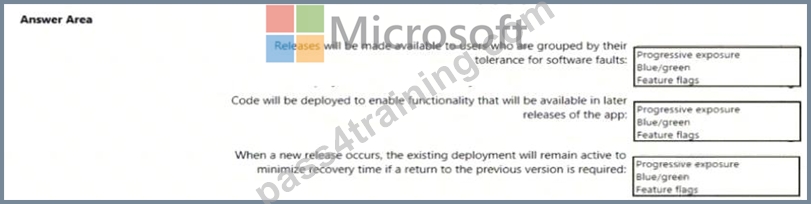
Answer:
Explanation:
Explanation
Box 1: Progressive exposure
Continuous Delivery may sequence multiple deployment "rings" for progressive exposure (also known as
"controlling the blast radius"). Progressive exposure groups users who get to try new releases to monitor their experience in "rings." The first deployment ring is often a "canary" used to test new versions in production before a broader rollout. CD automates deployment from one ring to the next and may optionally depend on an approval step, in which a decision maker signs off on the changes electronically. CD may create an auditable record of the approval in order to satisfy regulatory procedures or other control objectives.
Box 2: Feature flags
Feature flags support a customer-first DevOps mindset, to enable (expose) and disable (hide) features in a solution, even before they are complete and ready for release.
Box 3: Blue/green
Blue/green deployments which means that instead of replacing the previous version (here we refer to this version as blue), we bring up the new version (here referred to as the green version) next to the existing version, but not expose it to the actual users right away. On the condition of having successfully validated that the green version works correctly, we will promote this version to the public version by changing the routing configuration without downtime. If something is wrong with the green version we can revert back without users every noticing interruptions.
Reference:
https://docs.microsoft.com/en-us/azure/devops/learn/what-is-continuous-delivery
https://docs.microsoft.com/en-us/azure/devops/migrate/phase-features-with-feature-flags
https://medium.com/@denniszielke/continuous-kubernetes-blue-green-deployments-on-azure-using-nginx-appga
NEW QUESTION # 80
How should you configure the filters for the Project5 trigger? To answer, select the appropriate option in the answer area.
NOTE: Each correct selection is worth one point.
Answer:
Explanation:
Explanation
Scenario:
References: https://docs.microsoft.com/en-us/azure/devops/pipelines/build/triggers
Topic 2, Case Study: 1Overview
Existing Environment
Litware, Inc. e an independent software vendor (ISV) Litware has a main office and five branch offices.
Application Architecture
The company' s primary application is a single monolithic retirement fund management system based on ASP.NE T web forms that use logic written in V8.NET. Some new sections of the application are written in C#.
Variations of the application are created for individual customers. Currently, there are more than 80 have code branches in the application's code base.
The application was developed by using Microsoft Visual Studio. Source code is stored in Team Foundation Server (TFS) in the main office. The branch offices access of the source code by using TFS proxy servers.
Architectural Issues
Litware focuses on writing new code for customers. No resources are provided to refactor or remove existing code. Changes to the code base take a long time, AS dependencies are not obvious to individual developers.
Merge operations of the code often take months and involve many developers. Code merging frequently introduces bugs that are difficult to locate and resolve.
Customers report that ownership costs of the retirement fund management system increase continually. The need to merge unrelated code makes even minor code changes expensive.
Requirements
Planned Changes
Litware plans to develop a new suite of applications for investment planning. The investment planning Applications will require only minor integration with the easting retirement fund management system.
The investment planning applications suite will include one multi-tier web application and two iOS mobile applications. One mobile application will be used by employees; the other will be used by customers.
Litware plans to move to a more agile development methodology. Shared code will be extracted into a series of package.
Litware has started an internal cloud transformation process and plans to use cloud based services whenever suitable.
Litware wants to become proactive m detecting failures, rather than always waning for customer bug reports.
Technical Requirements
The company's investment planning applications suite must meet the following technical requirements:
* New incoming connections through the firewall must be minimized.
* Members of a group named Developers must be able to install packages.
* The principle of least privilege must be used for all permission assignments
* A branching strategy that supports developing new functionality in isolation must be used.
* Members of a group named Team leaders must be able to create new packages and edit the permissions of package feeds
* Visual Studio App Center must be used to centralize the reporting of mobile application crashes and device types in use.
* By default, all App Center must be used to centralize the reporting of mobile application crashes and device types in use.
* Code quality and release quality are critical. During release, deployments must not proceed between stages if any active bugs are logged against the release.
* The mobile applications must be able to call the share pricing service of the existing retirement fund management system. Until the system is upgraded, the service will only support basic authentication over HUPS.
* The required operating system configuration tor the test servers changes weekly. Azure Automation State Configuration must be used to ensure that the operating system on each test servers configured the same way when the servers are created and checked periodically.
Current Technical
The test servers are configured correctly when first deployed, but they experience configuration drift over time. Azure Automation State Configuration fails to correct the configurations.
Azure Automation State Configuration nodes are registered by using the following command.
NEW QUESTION # 81
SIMULATION
You plan to deploy a template named D:\Deploy.json to a resource group named Deploy-lod9940427.
You need to modify the template to meet the following requirements, and then to deploy the template:
* The address space must be reduced to support only 256 total IP addresses.
* The subnet address space must be reduced to support only 64 total IP addresses.
To complete this task, sign in to the Microsoft Azure portal.
- A. 1. Sign in to the portal,
2. Choose template Deploy-lod9940427
3. Select Edit template, and then paste your JSON template code into the code window.
4. Change the ASddressPrefixes to 10.0.0.0/24 in order to support only 256 total IP addresses.
addressSpace":{"addressPrefixes": ["10.0.0.0/24"]},
5. Change the firstSubnet addressprefix to 10.0.0.0/26 to support only 64 total IP addresses.
"subnets":[
{
"name":"firstSubnet",
"properties":{
"addressPrefix":"10.0.0.0/24"
}
6. Select Save.
7. Select Edit parameters, provide values for the parameters that are shown, and then select OK.
8 Select Subscription. Choose the subscription you want to use, and then select OK.
9. Select Resource group. Choose an existing resource group or create a new one, and then select OK.
10. Select Create. A new tile on the dashboard tracks the progress of your template deployment. - B. 1. Sign in to the portal,
2. Choose template Deploy-lod9940427
3. Select Edit template, and then paste your JSON template code into the code window.
4. Change the ASddressPrefixes to 10.0.0.0/24 in order to support only 256 total IP addresses.
addressSpace":{"addressPrefixes": ["10.0.0.0/24"]},
5. Change the firstSubnet addressprefix to 10.0.0.0/26 to support only 64 total IP addresses.
"subnets":[
{
"name":"firstSubnet",
"properties":{
"addressPrefix":"10.0.0.0/24"
}
6. Select Save.
7. Select Edit parameters, provide values for the parameters that are shown, and then select OK.
8 Select Subscription. Choose the subscription you want to use, and then select OK.
9. Select Resource group. Choose an existing resource group or create a new one, and then select OK.
10. Select Create. A new tile on the dashboard tracks the progress of your template deployment.
Answer: A
Explanation:
References:
https://docs.microsoft.com/en-us/azure-stack/user/azure-stack-deploy-template-portal?view=azs-1908
https://docs.microsoft.com/en-us/azure/architecture/building-blocks/extending-templates/update-resource
NEW QUESTION # 82
Your company develops a client banking application that processes a large volume of data.
Code quality is an ongoing issue for the company. Recently, the code quality has deteriorated because of an increase in time pressure on the development team.
You need to implement static code analysis.
During which phase should you use static code analysis?
- A. production release
- B. integration testing
- C. build
- D. staging
Answer: C
Explanation:
The Secure Development Lifecycle (SDL) Guidelines recommend that teams perform static analysis during the implementation phase of their development cycle.
Note: The company should focus in particular on the implementation of DevOps tests to assess the quality of the software from the planning stage to the implementation phase of the project.
Reference:
https://secdevtools.azurewebsites.net/
NEW QUESTION # 83
You have the Azure DevOps pipeline shown in the following exhibit.
Use the drop-down menus to select the answer choice that completes each statement based on the information presented in the graphic.
Answer:
Explanation:
Explanation
Box 1: 1
The Cloud agent job only.
Box 2: 4
The pipelines has the four tasks: NuGet restore, Compile Application, Copy Files, and Publish Artifact.
Reference:
https://azuredevopslabs.com/labs/azuredevops/continuousintegration/
NEW QUESTION # 84
You use Azure SQL Database Intelligent Insights and Azure Application Insights for monitoring.
You need to write ad-hoc queries against the monitoring data.
Which query language should you use?
- A. Transact-SQL
- B. PL/SQL
- C. PL/pgSQL
- D. Kusto Query Language (KQL)
Answer: D
Explanation:
Azure Monitor Logs is based on Azure Data Explorer, and log queries are written using the same Kusto query language (KQL). This is a rich language designed to be easy to read and author, and you should be able to start using it with minimal guidance.
Reference:
https://docs.microsoft.com/en-us/azure/azure-monitor/log-query/log-query-overview
NEW QUESTION # 85
You have a private distribution group that contains provisioned and unprovisioned devices.
You need to distribute a new iOS application to the distribution group by using Microsoft Visual Studio App Center.
What should you do?
- A. Request the Apple ID associated with the user of each device.
- B. Register the devices on the Apple Developer portal.
- C. Create an active subscription in App Center Test.
- D. Add the device owner to the organization in App Center.
Answer: B
Explanation:
Explanation
When releasing an iOS app signed with an ad-hoc or development provisioning profile, you must obtain tester's device IDs (UDIDs), and add them to the provisioning profile before compiling a release. When you enable the distribution group's Automatically manage devices setting, App Center automates the before mentioned operations and removes the constraint for you to perform any manual tasks. As part of automating the workflow, you must provide the user name and password for your Apple ID and your production certificate in a .p12 format.
App Center starts the automated tasks when you distribute a new release or one of your testers registers a new device. First, all devices from the target distribution group will be registered, using your Apple ID, in your developer portal and all provisioning profiles used in the app will be generated with both new and existing device ID. Afterward, the newly generated provisioning profiles are downloaded to App Center servers.
References:
https://docs.microsoft.com/en-us/appcenter/distribution/groups
NEW QUESTION # 86
You have an Azure subscription that contains an Azure Active Directory (Azure AD) tenant.
You are configuring a build pipeline in Azure Pipelines that will include a task named Task1. Task1 will authenticate by using an Azure AD service principal.
Which three values should you configure for Task1? Each correct answer presents part of the solution.
NOTE: Each correct selection is worth one point.
- A. the object ID
- B. the subscription ID
- C. the app ID
- D. the client secret
- E. the tenant ID
Answer: B,C,E
Explanation:
Create an Azure Resource Manager service connection with an existing service principal AB: Enter the information about your service principal into the Azure subscription dialog textboxes:
* Tenant ID
* Subscription ID
* Subscription name
* Service principal ID
Either the service principal client key or, if you have selected Certificate, enter the contents of both the certificate and private key sections of the *.pem file.
D: To deploy to a specific Azure resource, the task will need additional data about that resource.
If you're using the classic editor, select data you need. For example, the App service name.
If you're using YAML, then go to the resource in the Azure portal, and then copy the data into your code. For example, to deploy a web app, you would copy the name of the App Service into the WebAppName value.
Reference:
https://docs.microsoft.com/en-us/azure/devops/pipelines/library/connect-to-azure
NEW QUESTION # 87
You are creating a build pipeline in Azure Pipelines.
You define several tests that might fail due to third-party applications.
You need to ensure that the build pipeline completes successfully if the third-party applications are unavailable.
What should you do?
- A. Add the Requirements quality widget to your dashboard
- B. Increase the test pass percentage
- C. Configure flaky tests
- D. Configure the build pipeline to use parallel jobs
Answer: A
Explanation:
Explanation
Explanation:
Requirements traceability is the ability to relate and document two or more phases of a development process, which can then be traced both forward or backward from its origin. Requirements traceability help teams to get insights into indicators such as quality of requirements or readiness to ship the requirement. A fundamental aspect of requirements traceability is association of the requirements to test cases, bugs and code changes.
Reference:
https://docs.microsoft.com/en-us/azure/devops/pipelines/test/requirements-traceability
NEW QUESTION # 88
Your company has an Azure subscription.
The company requires that all resource group in the subscription have a tag named organization set to a value of Contoso.
You need to implement a policy to meet the tagging requirement.
How should you complete the policy? To answer, select the appropriate options in the answer area.
NOTE: Each correct selection is worth one point.
Answer:
Explanation:
Explanation
Box 1: " Microsoft.Resources/subscriptions/resourceGroups"
Box 2: "Deny",
Sample - Enforce tag and its value on resource groups
},
"policyRule": {
"if": {
"allOf": [
{
"field": "type",
"equals": "Microsoft.Resources/subscriptions/resourceGroups"
},
{
"not": {
"field": "[concat('tags[',parameters('tagName'), ']')]",
"equals": "[parameters('tagValue')]"
}
}
]
},
"then": {
"effect": "deny"
}
}
}
}
References:
https://docs.microsoft.com/en-us/azure/governance/policy/samples/enforce-tag-on-resource-groups
NEW QUESTION # 89
Your company develops an app for iOS. All users of the app have devices that are members of a private distribution group in Microsoft Visual Studio App Center.
You plan to distribute a new release of the app.
You need to identify which certificate file you require to distribute the new release from App Center.
Which file type should you upload to App Center?
- A. .cer
- B. .p12
- C. .pvk
- D. .pfx
Answer: B
Explanation:
A successful IOS device build will produce an ipa file. In order to install the build on a device, it needs to be signed with a valid provisioning profile and certificate. To sign the builds produced from a branch, enable code signing in the configuration pane and upload a provisioning profile (.mobileprovision) and a valid certificate (.p12), along with the password for the certificate.
References:
https://docs.microsoft.com/en-us/appcenter/build/xamarin/ios/
NEW QUESTION # 90
Your company creates a new Azure DevOps team.
You plan to use Azure DevOps for sprint planning.
You need to visualize the flow of your work by using an agile methodology.
Which Azure DevOps component should you use?
- A. Kanban boards
- B. delivery plans
- C. portfolio backlogs
- D. sprint planning
Answer: A
Explanation:
Customizing Kanban boards
To maximize a team's ability to consistently deliver high quality software, Kanban emphasize two main practices. The first, visualize the flow of work, requires you to map your team's workflow stages and configure your Kanban board to match. Your Kanban board turns your backlog into an interactive signboard, providing a visual flow of work.
Reference:
https://azuredevopslabs.com/labs/azuredevops/agile/
NEW QUESTION # 91
Your company has a project in Azure DevOps.
You plan to create a release pipeline that will deploy resources by using Azure Resource Manager templates.
The templates will reference secrets stored in Azure Key Vault.
You need to recommend a solution for accessing the secrets stored in the key vault during deployments. The solution must use the principle of least privilege.
What should you include in the recommendation? To answer, drag the appropriate configurations to the correct targets. Each configuration may be used once, more than once, or not at all. You may need to drag the split bar between panes or scroll to view content.
NOTE: Each correct selection is worth one point.
Answer:
Explanation:
Explanation
Box 1: A key Vault advanced access policy
Box 2: RBAC
Management plane access control uses RBAC.
The management plane consists of operations that affect the key vault itself, such as:
* Creating or deleting a key vault.
* Getting a list of vaults in a subscription.
* Retrieving Key Vault properties (such as SKU and tags).
* Setting Key Vault access policies that control user and application access to keys and secrets.
References:
https://docs.microsoft.com/en-us/azure/azure-resource-manager/resource-manager-tutorial-use-key-vault
NEW QUESTION # 92
......
Microsoft AZ-400 (Designing and Implementing Microsoft DevOps Solutions) certification exam is designed for professionals who want to develop and implement DevOps practices using Microsoft technologies. AZ-400 exam measures the ability to manage build infrastructure, implement continuous integration and delivery, and configure release management and monitoring. It also evaluates candidates on their ability to integrate Microsoft technologies such as Azure, Visual Studio, and Microsoft Teams.
Microsoft AZ-400 Test Engine PDF - All Free Dumps: https://www.pass4training.com/AZ-400-pass-exam-training.html
Get New AZ-400 Certification – Valid Exam Dumps Questions: https://drive.google.com/open?id=1Dc7l_42qlMOUKrE2h3rOY3YZQCEpOyrz
