

[Sep-2025] Latest UiPath UiPath-SAIv1 Certification Practice Test Questions
Verified UiPath-SAIv1 Dumps Q&As - 1 Year Free & Quickly Updates
NEW QUESTION # 108
What is the recommended split of documents for training and evaluation, considering a total of 15 documents per vendor?
- A. 8 documents for training the model, and 7 for evaluating the model.
- B. 12 documents for training the model, and 3 for evaluating the model.
- C. 7 documents for training the model, and 8 for evaluating the model.
- D. 10 documents for training the model, and 5 for evaluating the model.
Answer: D
NEW QUESTION # 109
Which of the following OCR (Optical Character Recognition) engines is not free of charge?
- A. OmniPaqe.
- B. Microsoft OCR.
- C. Tesseract.
- D. Microsoft Azure OCR.
Answer: A
Explanation:
According to the UiPath documentation, OmniPaqe is a paid OCR engine that requires a license to use. It is one of the most accurate and reliable OCR engines available, and it supports over 200 languages. The other OCR engines listed are free of charge, but they may have different features, limitations, and performance levels. For example, Tesseract is an open-source OCR engine that supports over 100 languages, but it may not be as accurate as OmniPaqe. Microsoft Azure OCR and Microsoft OCR are both cloud-based OCR engines that use Microsoft's technology, but they have different capabilities and pricing models. Microsoft Azure OCR can process both printed and handwritten text, and it uses a pay-as-you-go model based on the number of transactions. Microsoft OCR can only process printed text, and it is included in the UiPath Studio license.
References:
* Document Understanding - OCR Engines
* Automation Pricing - Complete UiPath Enterprise Solution
NEW QUESTION # 110
Which scenario would be best accomplished using unattended automation?
- A. Providing on-demand assistance to users for specific activities.
- B. Generating invoices that require manual approval before issuing.
- C. Resolving customer queries with real-time input from support agents.
- D. Running reports and sending them via email to stakeholders overnight.
Answer: D
Explanation:
Unattended automation is ideal for tasks that can run independently without human intervention, such as scheduled activities during off-hours. Running reports and emailing stakeholders overnight is a perfect use case for unattended bots, which can execute the process autonomously.
NEW QUESTION # 111
What is the correct order of migrating a dataset from Document Manager to a Modern Project? Instructions:
Drag the Description found on the left and drop on the correct Step found on the right.
Answer:
Explanation: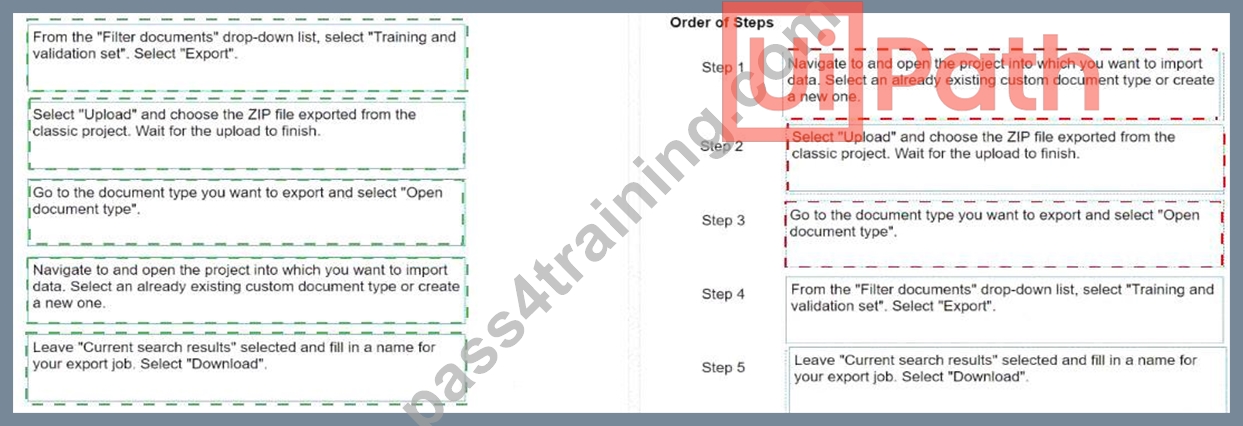
Explanation:
To organize the steps in the correct order for migrating a dataset from the Document Manager to a Modern Project, I'll analyze the instructions and then match the steps accordingly. Here's the logical order based on the descriptions:
* Step 1: Navigate to and open the project into which you want to import data. Select an already existing custom document type or create a new one.
* Step 2: Select "Upload" and choose the ZIP file exported from the classic project. Wait for the upload to finish.
* Step 3: Go to the document type you want to export and select "Open document type."
* Step 4: From the "Filter documents" drop-down list, select "Training and validation set." Select
"Export."
* Step 5: Leave "Current search results" selected and fill in a name for your export job. Select
"Download."
This should reflect the correct sequential process of migrating a dataset from Document Manager to a Modern Project.
NEW QUESTION # 112
What is the Document Object Model (DOM) in the context of Document Understanding?
- A. The DOM is a graphical user interface (GUI) tool in UiPath Document Understanding that provides visual representations of documents, making it easier for users to navigate and interact with the content.
- B. The DOM is a feature that allows you to convert physical documents into virtual objects that can be manipulated using programming code.
- C. The DOM is a built-in artificial intelligence system that automatically understands and interprets the content and the type of documents, eliminating the need for manual data extraction.
- D. The DOM is a JSON object containing information such as name, content type, text length, number of pages, page rotation, detected language, content, and coordinates for the words identified in the file.
Answer: D
Explanation:
The Document Object Model (DOM) is a data representation of the objects that comprise the structure and content of a document on the web1. In the context of Document Understanding, the DOM is a JSON object that is generated by the Digitize Document activity, which uses the UiPath Document OCR engine to extract the text and layout information from the input document2. The DOM contains the following properties for each document3:
* name: The name of the document file.
* contentType: The MIME type of the document file, such as application/pdf or image/jpeg.
* textLength: The number of characters in the document text.
* pages: An array of objects, each representing a page in the document. Each page object has the following properties:
* pageNumber: The number of the page, starting from 1.
* rotation: The angle of rotation of the page, in degrees. A positive value indicates clockwise rotation, and a negative value indicates counterclockwise rotation.
* language: The language code of the page, such as en or fr.
* content: An array of objects, each representing a word or a line in the page. Each content object has the following properties:
* type: The type of the content, either word or line.
* text: The text of the content.
* boundingBox: An array of four numbers, representing the coordinates of the top-left and bottom-right corners of the content, in the format [x1, y1, x2, y2]. The coordinates are relative to the page, with the origin at the top-left corner, and the unit is pixel.
* confidence: A number between 0 and 1, indicating the confidence level of the OCR engine in recognizing the content.
The DOM can be used as an input for other activities in the Document Understanding framework, such as Classify Document Scope, Data Extraction Scope, or Export Extraction Results. The DOM can also be manipulated using programming code, such as JavaScript or Python, to perform custom operations on the document data.
References:
1: Introduction to the DOM - Web APIs | MDN 2: Digitize Document 3: Document Object Model
NEW QUESTION # 113
What do entity predictions refer to within UiPath Communications Mining?
- A. The difference between label suggestions and label predictions in a training process.
- B. The identification of a specific span of text as a value for a particular entity type.
- C. The model's confidence that a specific concept exists within a communication.
- D. The understanding of the parent-label relationship when assigning label predictions.
Answer: B
NEW QUESTION # 114
Having the taxonomy in a file, shared and updated across multiple projects, what is the most convenient way to load it in a UiPath Studio project?
- A. Using Read Taxonomy activity.
- B. Using DeserializeTaxonomy activity.
- C. Using DocumentTaxonomy.Deserialize method inside an Assign activity.
- D. Using Load Taxonomy activity.
Answer: D
NEW QUESTION # 115
Why is having high coverage important for an automation-focused use case in UiPath Communications Mining?
- A. High coverage ensures that the software consumes less computational resources, resulting in cost savings for the organization implementing the automation.
- B. High coverage on the model means that fewer communications will be sent for manual review and that fewer automatable processes are missed.
- C. With high coverage, you can increase the amount of data provided downstream via Streams.
- D. The higher the coverage, the lower the model's recall, resulting in greater throughput of automatable processes.
Answer: B
Explanation:
In UiPath Communications Mining, high coverage ensures that a larger proportion of communications is classified with meaningful labels, meaning fewer communications are sent for manual review and more processes are captured for automation. This leads to more effective automation, reducing the need for human intervention and ensuring that the automation use case is fully realized.
For more details, refer to:
* UiPath Communications Mining Performance Metrics: Coverage and Automation
NEW QUESTION # 116
Which of the following extractors can be used for Data Extraction Scope activity?
- A. Form Extractor Incremental Extractor Machine Learning Extractor and Intelligent Form Extractor
- B. Regex Based Extractor. Form Extractor. Intelligent Form Extractor, and Machine Learning Extractor.
- C. Full Extractor. Machine Learning Extractor, Intelligent Form Extractor, and Regex Based Extractor.
- D. Intelligent Form Extractor, Machine Learning Extractor. Logic Extractor, and Regex Based Extractor.
Answer: B
Explanation:
The Data Extraction Scope activity provides a scope for extractor activities, enabling you to configure them according to the document types defined in your taxonomy. The output of the activity is stored in an ExtractionResult variable, containing all automatically extracted data, and can be used as input for the Export Extraction Results activity. This activity also features a Configure Extractors wizard, which lets you specify exactly what fields from the document types defined in the taxonomy you want to extract1.
The extractors that can be used for Data Extraction Scope activity are:
* Regex Based Extractor: This extractor enables you to use regular expressions to extract data from text documents. You can define your own expressions or use the predefined ones from the Regex Based Extractor Configuration wizard2.
* Form Extractor: This extractor enables you to extract data from semi-structured documents, such as invoices, receipts, or purchase orders, based on the position and relative distance of the fields. You can define the templates for each document type using the Form Extractor Configuration wizard3.
* Intelligent Form Extractor: This extractor enables you to extract data from semi-structured documents, such as invoices, receipts, or purchase orders, based on the labels and values of the fields. You can define the fields for each document type using the Intelligent Form Extractor Configuration wizard.
* Machine Learning Extractor: This extractor enables you to extract data from any type of document, using a machine learning model that is trained on your data. You can use the predefined models from UiPath or your own custom models hosted on AI Center or other platforms. You can configure the fields and the model for each document type using the Machine Learning Extractor Configuration wizard.
References: 1: Data Extraction Scope 2: Regex Based Extractor 3: Form Extractor 4: Intelligent Form Extractor
5: Machine Learning Extractor
NEW QUESTION # 117
What is the correct order of recommended steps when introducing new labels into a mature taxonomy?
Instructions: Drag the steps found on the "Left" and drop them on the "Right" in the correct order.
Answer:
Explanation:
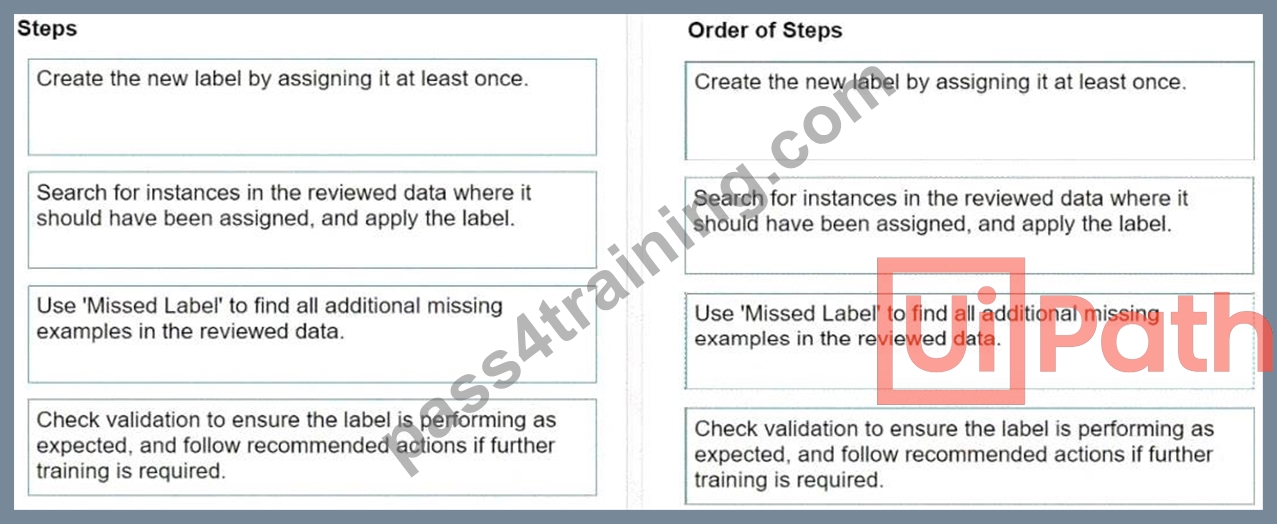
* Create the new label by assigning it at least once. This is the initial step to introduce a new category or classification within your data taxonomy.
* Search for instances in the reviewed data where the new label should have been assigned, and apply the label accordingly. This step is crucial for maintaining consistency across your data set.
* Use 'Missed Label' to find all additional missing examples in the reviewed data. This action helps in identifying and rectifying any instances that may have been overlooked during the initial review.
* Check validation to ensure the label is performing as expected, and follow recommended actions if further training is required. Validation is key to assess the accuracy and performance of the new label within the system.
NEW QUESTION # 118
What is the main purpose of the Document Understanding Process template in UiPath Studio?
- A. To offer a fully functional document processing tool that is easy to use and execute.
- B. To eliminate the need for exception handling in workflows.
- C. To integrate with other connected automations seamlessly.
- D. To create custom workflows from scratch.
Answer: A
Explanation:
The main purpose of the Document Understanding Process template in UiPath Studio is to provide users with a ready-to-use document processing framework. It is designed to simplify the development of document understanding automations by offering out-of-the-box features like logging, exception handling, and retry mechanisms. This template allows developers to quickly start working on both simple demos and large-scale document processing projects without needing to build everything from scratch. It is equipped with key components such as classifiers and extractors to streamline document classification and data extraction workflows
NEW QUESTION # 119
How many types of synchronization mechanisms exist in the Document Understanding Process to prevent multiple robots to write in a file at the same time?2
- A. 0
- B. 1
- C. 2
- D. 3
Answer: B
NEW QUESTION # 120
If you need to retrieve an item based on a corresponding identifier in UiPath, which collection type would you use?
- A. System.Collections.Generic.Dictionary<TKey, TValue> as it stores indexed values
- B. System.Collections.Generic.List<T> as it stores ordered values
- C. ArrayOf<T> or System.DataType[] as it stores indexed values
- D. System.Collections.Generic.Dictionary<TKey, TValue> as it stores key-value pairs
Answer: D
NEW QUESTION # 121
Which activity should be used for classification validation in attended mode?
- A. Wait for Document Classification and Resume.
- B. Train Classifiers Scope.
- C. Present Classification Station.
- D. Create Document Classification Action.
Answer: C
NEW QUESTION # 122
What is a reason for pinning a UiPath Communications Mining Model?
- A. To allow rollback of annotations to that model version.
- B. To force the Ul to show predictions from that model version in explore
- C. To allow AB comparing of the statistics of that model version with another one.
- D. To delete all other model versions.
Answer: B
Explanation:
In UiPath Communications Mining, pinning a model ensures that the predictions shown in the Explore tab are generated from that specific model version. This feature allows users to control which version of the model is actively making predictions, particularly during evaluation or comparison stages. By pinning a model, the user ensures that the UI reflects the predictions from the selected version, helping maintain consistency when analyzing results or making changes.
For more details, refer to:
* UiPath Communications Mining: Model Management and Pinning
* UiPath AI Center Documentation: Managing Model Versions
NEW QUESTION # 123
What is the correct order of uploading a package exported from UiPath AI Center?
Instructions: Drag the steps found on the "Left" and drop them on the "Right" in the correct order.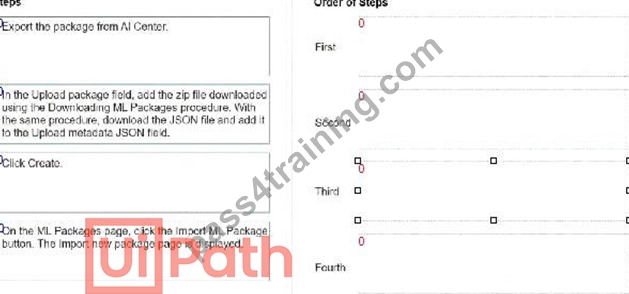
Answer:
Explanation:
Explanation:
* Export the package from AI Center. This is the first step where you prepare the package to be moved.
* On the ML Packages page, click the Import ML Package button. This step is where you start the process of importing the package you've exported.
* On the Upload package field, add the zip file downloaded using the Downloading ML Packages procedure. After starting the import process, you will upload the actual package.
* Click Create. This is the final step where you finalize the uploading process of your ML package.
Please proceed with these steps in the UiPath AI Center to upload your exported package correctly.
NEW QUESTION # 124
What do entities represent in UiPath Communications Mining?
- A. Metadata properties.
- B. Structured data points.
- C. Thread properties.
- D. Concepts, themes, and intents.
Answer: D
Explanation:
Entities are additional elements of structured data which can be extracted from within the verbatims. Entities include data such as monetary quantities, dates, currency codes, organisations, people, email addresses, URLs, as well as many other industry specific categories. Entities represent concepts, themes, and intents that are relevant to the business use case and can be used for filtering, searching, and analyzing the verbatims.
References:
* Communications Mining - Entities
* Communications Mining - Using Entities in your Application
* Communications Mining - Configuring Entities
NEW QUESTION # 125
Which of the following functionalities does UiPath Assistant provide?
- A. Running, managing, and organizing automation workflows on the user's machine.
- B. Analyzing processes to determine optimal automation solutions.
- C. Scheduling and monitoring robot processes in Orchestrator.
- D. Developing automation workflows in UiPath Studio.
Answer: A
NEW QUESTION # 126
What is the function of the Immediate Panel in UiPath Studio during the debugging process?
- A. Modifying the values of variables and arguments at runtime during the debugging process.
- B. Displaying the next activity to be executed and its parent containers when the project is paused in debugging.
- C. Inspecting data at a certain point during debugging by evaluating variables, arguments, or statements.
- D. Displaying the performance analysis of all the operations, showing the execution time of each activity.
Answer: C
NEW QUESTION # 127
What is a mandatory requirement before using the One Click Classification functionality?
- A. The Document Understanding project must be linked to Action Center.
- B. The Document Understanding project must be linked to AI Center.
- C. The Document Understanding project must have at least five Document Types defined.
- D. The Document Understanding project must be linked to AI Fabric.
Answer: B
NEW QUESTION # 128
What is the default visibility of an ML skill?
- A. An ML skill is by default public and can't be made private.
- B. An ML skill is by default private and can be made public.
- C. An ML skill is by default private and can't be made public.
- D. An ML skill is by default public and can be made private.
Answer: B
Explanation:
An ML skill is a consumer-ready, live deployment of an ML or OS package that can be used in RPA workflows. By default, an ML skill is private, which means it can only be accessed by the users who have the permission to view and manage the project that contains the skill. However, an ML skill can be made public by enabling the Public Skill option in the ML Skill Details page. This will generate a public URL and an API key for the skill, which can be used to access the skill from any external system or application12.
References: 1: AI Center - About ML Skills 2: Make ML Skills and Datasets public via URL + API Key - Preview
NEW QUESTION # 129
......
Latest 2025 Realistic Verified UiPath-SAIv1 Dumps - 100% Free UiPath-SAIv1 Exam Dumps: https://www.pass4training.com/UiPath-SAIv1-pass-exam-training.html
Get 2025 Updated Free UiPath UiPath-SAIv1 Exam Questions and Answer: https://drive.google.com/open?id=1aO6SIKOyM7w2grs9ivCOeIkOb_1QWHkd
