

2023 Realistic 4A0-116 Dumps Latest Nokia Practice Tests Dumps
4A0-116 Dumps PDF - 4A0-116 Real Exam Questions Answers
Nokia 4A0-116 certification exam is intended for IT professionals who are involved in designing, implementing, and managing segment routing networks using Nokia's technologies. This includes network engineers, network architects, network administrators, and IT consultants who work with Nokia's solutions and technologies.
To prepare for the Nokia 4A0-116 exam, candidates should have a solid understanding of networking principles, routing protocols, and network infrastructure. They should also be familiar with Nokia's networking products and solutions, including the Nokia Network Services Platform (NSP) and the Nokia Service Router Operating System (SROS). With the Nokia 4A0-116 certification, professionals will have the knowledge and skills needed to design, implement, and manage complex network infrastructures using Nokia Segment Routing technology.
Nokia 4A0-116 certification exam covers a range of topics related to segment routing, including the fundamentals of segment routing, the architecture and components of Nokia SR solutions, the configuration and deployment of segment routing policies, and the troubleshooting and optimization of segment routing networks. Nokia Segment Routing Exam certification exam is intended to help IT professionals acquire the necessary skills and knowledge to implement and manage segment routing solutions efficiently and effectively.
NEW QUESTION # 10
For any of the LFA methods to work properly, there must be a router in the backup path that will forward traffic addressed to the destination without sending it back to the source. Which of the following statements describes the way R-LFA selects such a router?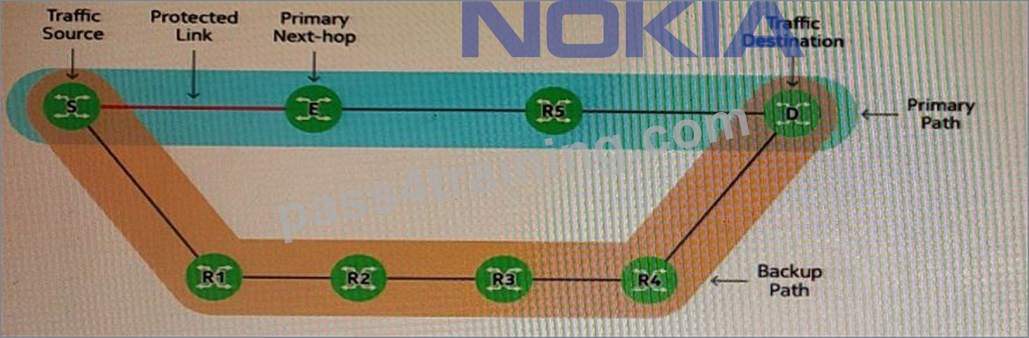
- A. It selects a remote router, reachable through a tunnel defined by a single Node-SID.
- B. It selects a remote router, reachable through a tunnel defined by a Node-SID and one or two Adjacency-SIDs.
- C. It selects an immediate neighbor.
- D. It can select an immediate neighbor or a remote router, as long as the backup path coincides with the path that will become active after IGP reconvergence.
Answer: D
Explanation:
R-LFA (Remote Loop-Free Alternate) is a method that can select either an immediate neighbor or a remote router to be used as a backup next hop, as long as the backup path coincides with the path that will become active after IGP reconvergence.
NEW QUESTION # 11
Which of the following list of SR-TE attributes has to be advertised among routers?
- A. Administrative groups that each link belongs to, TE metric of links, bandwidth availability of each link, SRLG that each link belongs to.
- B. Administrative groups that each link belongs to, TE metric of links, SRLG that each link belongs to, link status up/down.
- C. Administrative groups that each link belongs to, TE metric of links, bandwidth availability of each link, SRLG that each link belongs to, link status up/down.
- D. Administrative groups that each link belongs to, TE metric of links, SRLG that each link belongs to.
Answer: A
Explanation:
In SR-TE, routers need to advertise certain attributes of their links to other routers in the network in order to calculate traffic-engineered paths. These attributes include:
Administrative groups that each link belongs to: This information is used to restrict the use of certain links to specific traffic types or groups.
TE metric of links: This information is used to calculate the cost of using a particular link for a traffic-engineered path.
Bandwidth availability of each link: This information is used to control the amount of traffic that can be sent over a particular link.
SRLG that each link belongs to: This information is used to avoid routing over the same physical link. Link status up/down is not needed to be advertised as it is part of the IGP protocol and is used to check the reachability of a link.
NEW QUESTION # 12
Which of the following is NOT a valid option to steer traffic into a flex-algo segment-routing tunnel?
- A. Using a flex-algo Node-SID as an explicit hop in the path definition of an SR-TE LSP and enabling the sr-te tunnel type for a VPN service.
- B. Specifying the flex-algo instance ID as an additional TE constraint for an SR-TE LSP and enabling the sr-te tunnel type for a VPN service.
- C. Configuring and applying a VRF import policy to a VPRN service and enabling the sr-is-is or sr-ospf tunnel type for the service, depending on the underlying routing protocol.
- D. Configuring and applying a VSI import policy to an EVPN service and enabling the sr-is-is or sr-ospf tunnel type for the service, depending on the underlying routing protocol.
Answer: D
Explanation:
Applying a VSI import policy to an EVPN service and enabling the sr-is-is or sr-ospf tunnel type for the service is not a valid option for steering traffic into a flex-algo segment-routing tunnel, VSI is not related to flex-algo SR.
NEW QUESTION # 13
Based on the exhibit, and given that the system IP address of router RIO is 10.10.10.10, which of the following statements is FALSE?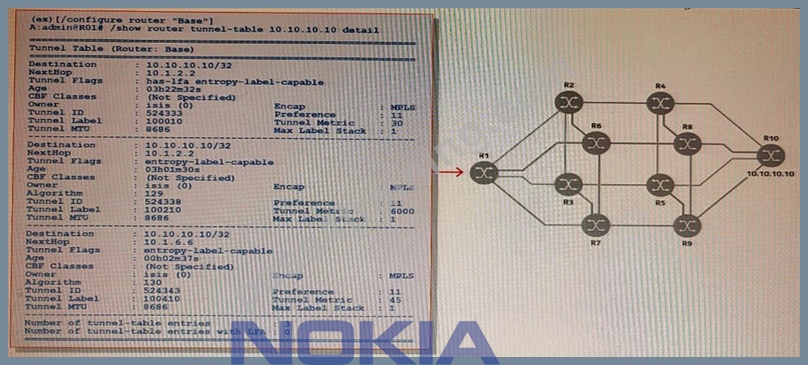
- A. The Node-SID assigned to router RIO for flex-algo instance 129 is 524338.
- B. Router RIO participates in flex-algo instance 130.
- C. Router Rl participates in at least two flex-algo instances.
- D. The underlying routing protocol being used in the network for segment routing is IS-IS.
Answer: A
NEW QUESTION # 14
Which of the following is an advantage of enabling label stack reduction for a CSPF-calculated path, as compared to using plain CSPF?
- A. The number of hops included in the end-to-end path is reduced.
- B. The path calculation can be delegated to an external path computation element (PCE).
- C. The routers in the calculated path can take advantage of ECMP to better distribute the traffic load.
- D. There is a larger list of traffic-engineering constraint types that can be imposed on the LSP path.
Answer: A
Explanation:
Once a path is associated with an LSP, it cannot be used by other LSPs is False. A path can be used by multiple LSPs, but each LSP can have different attributes like bandwidth, priority and other constraints.
NEW QUESTION # 15
Which of the following types of information is considered by a stateless PCE when it processes a new LSP path calculation request?
- A. The IGP link-state database
- B. The operational state of existing LSP paths
- C. The amount of bandwidth reserved for each of the existing LSP paths
- D. The traffic-engineering database
Answer: A
NEW QUESTION # 16
In the context of a network that includes a Path Computation Element (PCE), what is a PCC-initiated LSP?
- A. An LSP for which the initial path is calculated by the head-end router.
- B. An LSP whose existence and state are reported to the PCE.
- C. An LSP for which the path repairs and re-optimizations must be triggered by the head-end router.
- D. An LSP that needs to be explicitly configured on the head-end router.
Answer: B
Explanation:
A PCC-initiated LSP is an LSP that is established and controlled by the PCC (Path Computation Client) which is typically a head-end router. The PCC sends LSP setup and teardown requests to the PCE and also reports the existence and state of the LSPs to the PCE. The PCE then uses this information to perform path computation and to monitor the state of the LSPs.
NEW QUESTION # 17
Which of the following statements about a Segment Routing SID is FALSE?
- A. A Prefix-SID can be configured directly as a label value or indirectly as an index.
- B. Adjacency-SID values are taken from the SRGB configured for the routing protocol.
- C. An Adjacency-SID does not have to be configured.
- D. A Node-SID is usually associated with a router's system interface.
Answer: C
Explanation:
An Adjacency-SID does not have to be configured: this statement is not true, An Adjacency-SID is associated with a neighbor router, it is used to identify an adjacency between two routers. An Adjacency-SID must be configured to identify the adjacency.
NEW QUESTION # 18
Which of the following statements about Multi-Protocol Label Switching networks is FALSE?
- A. The data is transparently carried from end to end.
- B. MPLS uses a signaling protocol to exchange labels between routers.
- C. An LSR forwards data based on the MPLS labels.
- D. An LSP is a bi-directional tunnel that uses MPLS labels to forward data.
Answer: A
Explanation:
The data is transparently carried from end to end: This statement is not true, MPLS does not provide data transparency, which means that the data is not carried unmodified from end to end. MPLS uses labels to forward data, so the original IP packets are encapsulated in new MPLS packets, and the original IP headers are not visible at the egress LSR.
NEW QUESTION # 19
In which of the following aspects does the configuration of flex-algo LSPs have an advantage over the configuration of SR-TE LSPs?
- A. Ability to associate one primary and up to two secondary paths to the same LSP
- B. Flexibility of configuring each LSP with its own set of traffic-engineering constraints
- C. List of traffic-engineering constraint types available to choose from
- D. Label stack size of the encapsulated data packets
Answer: B
Explanation:
Flex-Algo LSPs are a type of LSP that allows for greater flexibility in configuring traffic engineering constraints. This is because flex-algo LSPs can be configured with a unique set of traffic engineering constraints for each LSP, whereas SR-TE LSPs use a predefined set of traffic engineering constraints that applies to all LSPs.
Label stack size of the encapsulated data packets, List of traffic-engineering constraint types available to choose from, and Ability to associate one primary and up to two secondary paths to the same LSP are not the advantages of flex-algo LSPs over SR-TE LSPs.
NEW QUESTION # 20
The exhibit shows the fast re-route configuration on router R1, in which both R-LFA and TI-LFA have been enabled. Assume that there are multiple potential backup paths for a given prefix. Which of the following options will router R1 use?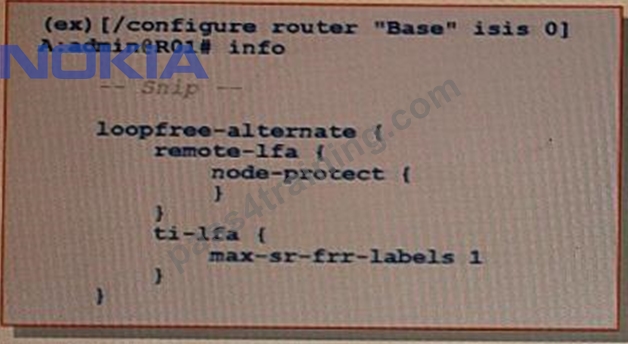
- A. A standard LFA path that would not coincide with the path after IGP re-convergence.
- B. A D-LFA path that would coincide with the path after IGP re-convergence.
- C. An R-LFA path that would not coincide with the path after IGP re-convergence.
- D. A D-LFA path that would not coincide with the path after IGP re-convergence.
Answer: B
Explanation:
The exhibit shows that both R-LFA and TI-LFA have been enabled on router R1. R-LFA (Remote Loop-Free Alternate) is a method that is used to protect the active segment of a tunnel, and it allows the router to find a backup path that coincides with the path that will become active after IGP reconvergence. TI-LFA (Topology Independent LFA) is a method that is used to protect an end-to-end multi-segment tunnel, it allows the router to find a backup path that does not rely on the IGP topology, but on the segment routing topology.
With R-LFA and TI-LFA enabled, router R1 will use a D-LFA (Dual-Loop-Free Alternate) path, which is a combination of both R-LFA and TI-LFA, this path will coincide with the path after IGP re-convergence.
A standard LFA, R-LFA, and D-LFA which do not coincide with the path after IGP re-convergence are not the options.
NEW QUESTION # 21
Which of the following statements about the operation of seamless-BFD is FALSE?
- A. To be able to respond to seamless-BFD messages, a router must be configured as a reflector.
- B. A seamless-BFD template needs to be configured on the head-end of the LSP.
- C. Seamless-BFD responses are sent back using the LSP label stack.
- D. The routing protocol (OSPF or IS-IS) is used to carry the reflector discriminator information.
Answer: C
Explanation:
Seamless-BFD is a mechanism that allows the detection of faults in MPLS LSPs more quickly by using BFD (Bidirectional Forwarding Detection) protocol. Seamless-BFD responses are sent back using the MPLS data-plane, not the LSP label stack.
NEW QUESTION # 22
Which of the following statements about path definitions is FALSE?
- A. In addition to the hops defined in the path list, the head-end and tail-end routers are implicitly added.
- B. Once a path is associated with an LSP, it cannot be used by other LSPs.
- C. The path hops can be defined by either the system or physical interface IP address.
- D. A loose hop is one that does not have to be directly adjacent to the previous hop in the path list
Answer: C
NEW QUESTION # 23
Which of the following statements about the Path Computation Element (PCE) is FALSE?
- A. A stateful PCE proactively monitors all the existing LSPs and triggers the necessary repairs and re-optimizations.
- B. A stateless PCE can calculate cross-area traffic-engineering-constrained LSP paths.
- C. A stateful PCE can allow LSPs to reserve bandwidth.
- D. The PCE can obtain topology and traffic-engineering information from the network using either a link-state IGP or BGP-LS.
Answer: C
Explanation:
Stateful PCE can monitor the existing LSPs and trigger necessary repairs and re-optimizations, but it does not have the capability to reserve bandwidth.
NEW QUESTION # 24
Which of the following statements about SR-TE administrative constraints is FALSE?
- A. The head-end router may calculate a path that takes into account max hop count and bandwidth constraints.
- B. Shared-Risk-Link Groups are only taken into account when calculating the secondary path.
- C. A strict hop must be adjacent to the previous hop in the list.
- D. The TE metric for a link is by default the same as the IGP metric.
Answer: B
Explanation:
Shared-Risk-Link Groups(SRLG) is taken into account when calculating both primary and secondary path to avoid routing over the same physical link.
NEW QUESTION # 25
Examine the exhibit.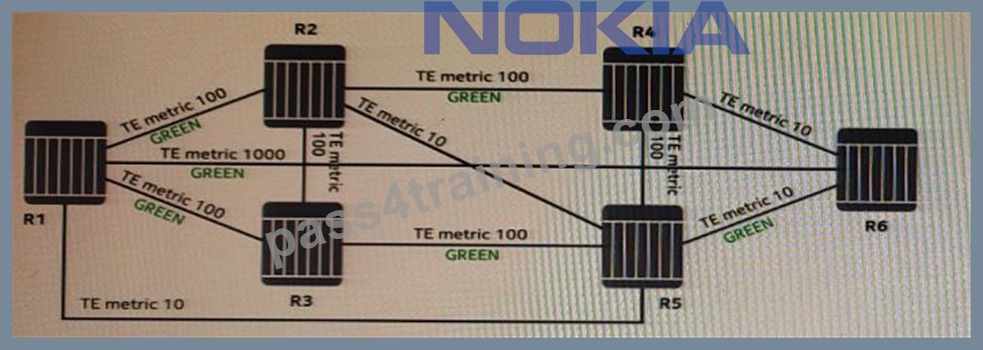
An LSP is being configured to start at R1 and end at R6 using local CSPF. The LSP has the following constraints. Include admin-group GREEN, use the TE metric and hop-limit 3. What routers will be included in the LSP path?
- A. R1, R6
- B. R1, R2, R4, R6
- C. R1, R5, R6
- D. R1, R3, R5, R6
Answer: D
NEW QUESTION # 26
......
4A0-116 Premium Exam Engine pdf Download: https://www.pass4training.com/4A0-116-pass-exam-training.html
4A0-116 Exam [2023] Dumps Nokia PDF Questions: https://drive.google.com/open?id=1Kj60njw2n5Uzy-7vDCG7aotvrqKIPPja
